There is no single best protein powder — the right one is the one that matches your allergen constraints, your protein-quality needs, and your tolerance for additives. Whey isolate scores highest for muscle protein synthesis and usually costs the least per gram, while pea and potato isolates are the strongest dairy-free options. The decision gets simpler once you know which of five variables actually applies to you.
The best protein powder depends on three things: what you cannot eat, how much protein quality you need, and how short you want the ingredient list. Whey isolate (90–95% protein, under 1% lactose) leads on muscle protein synthesis and price; pea and potato isolates lead among allergen-free options. Single-ingredient powders sidestep the contamination problem that the Clean Label Project’s 2025 Protein Study 2.0 found in 47% of 160 tested products, which exceeded at least one federal or state safety standard.
This is the hub page for our comparison cluster. Below is the overview; each section links down to a deeper guide on the specific decision. Read the table first, then jump to whichever consideration is your real constraint — most people only have one or two.
Protein Powder Types at a Glance
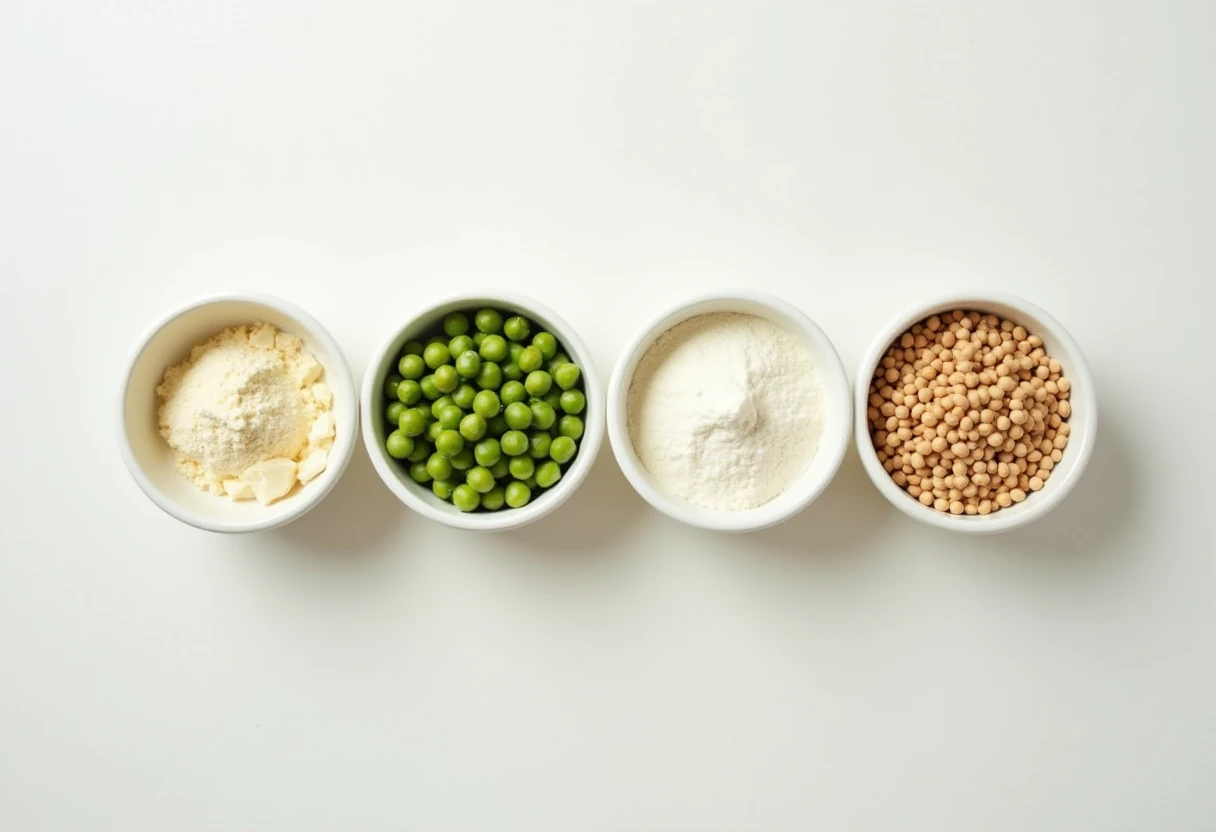
The protein-powder market was valued at $4.4 billion in 2021 and is projected to reach $19.3 billion by 2030, which is why the shelf is overwhelming. Underneath the marketing, almost every product is one of about eight base proteins. Here is how they compare on the dimensions buyers actually weigh.
| Protein type | Allergen status | Protein quality | Taste & mixability | Best suited to |
|---|---|---|---|---|
| Whey isolate | Dairy | High leucine; strong MPS response | Mild, mixes easily | Muscle gain, lowest cost per gram |
| Whey concentrate | Dairy + lactose | High leucine; lower protein % | Creamier, more carbs | Budget buyers without lactose issues |
| Casein | Dairy | Complete; slow digestion | Thick, pudding-like | Overnight or between-meal use |
| Pea isolate | Legume | Complete but low in methionine + cysteine | Earthy, can be gritty | Dairy-free, plant-based diets |
| Potato isolate | Allergy-free | MPS demonstrated in human trial | Neutral, low flavor | Allergy households, sensitive guts |
| Soy isolate | Soy | Complete; lower mTOR signaling than dairy | Beany, mixes well | Plant-based, cardiovascular focus |
| Rice isolate | Hypoallergenic | Low in lysine; usually blended | Chalky alone | Blends, sensitive stomachs |
| Egg white | Egg | Complete; PDCAAS 1.00 | Can foam, mild | Dairy-free but egg-tolerant |
| Collagen | Usually bovine/fish | Incomplete; no leucine effect on MPS | Flavorless, dissolves fully | Skin/joint goals, not muscle |
Which Protein Type Is Right for You?
The right protein type is decided mostly by what you cannot eat and what you are training for. If you tolerate dairy and want maximum muscle protein synthesis per dollar, whey isolate is the default. If dairy is out, pea, potato, soy, and egg white are the credible alternatives — and potato is the only one of those that is not itself a top-nine allergen.
Animal proteins generally score higher on protein-quality metrics than plant proteins, and they digest faster. In a study of young men, whey stimulated more post-exercise muscle protein synthesis than casein or soy, attributed to faster absorption and higher leucine content (Journal of Applied Physiology, 2009, PMID:19589961). That said, the gap is smaller than the marketing implies. A 2020 trial found that 25 g of potato protein isolate, taken twice daily, effectively stimulated muscle protein synthesis in young women, and the authors called potato protein a high-quality plant source (Nutrients, 2020, PMID:32349353).
Plant proteins also carry an upside that animal proteins do not: people who ate the highest ratio of plant-to-animal protein had a 19% lower risk of cardiovascular disease across three prospective cohorts (American Journal of Clinical Nutrition, 2024, PMID:39631999). For a full head-to-head on the two most-compared options, see our guides to potato protein vs whey and potato protein vs pea protein. If the words “complete” and “incomplete” trip you up, start with complete vs incomplete proteins.
How Much Does Protein Quality Matter?
Protein quality matters most if protein powder is your primary protein source and you are over 40, training hard, or eating at a deficit. Two scores capture it: PDCAAS (older, capped at 1.00) and DIAAS (newer, proposed by the FAO in 2013 to replace it). Egg protein scores a PDCAAS of 1.00; wheat gluten scores around 0.25.
The number that drives muscle protein synthesis specifically is leucine. Whey is leucine-dense, which is why 30 g of whey after resistance exercise raised myofibrillar protein synthesis above placebo while 30 g of collagen — leucine-poor — did not (Med Sci Sports Exerc, 2023, PMID:37202878). Plant proteins typically induce a lower, slower rise in essential amino acids than whey, but a well-formulated blend at an adequate dose can close that gap: a 32 g plant-protein blend (pea, brown rice, and canola) stimulated post-exercise myofibrillar protein synthesis comparably to an equal dose of whey, with no significant difference between the two (Med Sci Sports Exerc, 2024, PMID:38537270). Pea isolate illustrates the typical plant shortfall — lysine is abundant at about 7.9 g/100 g protein, but methionine plus cysteine is the limiting pair at only 2.6 g/100 g protein (Foods, 2024).
Potato protein is an exception worth noting: its PDCAAS is among the highest of any vegetable protein, and DIAAS for potato protein isolates has been reported as high as 100% (Food Science & Nutrition, Herreman et al., 2020, PMID:33133540). For the mechanics of how scores translate into absorbed grams, read protein digestibility, and to set a daily target, see how much protein per day for muscle gain.
Which Protein Powders Are Safe for Allergies?
The safest protein powders for allergy households are single-ingredient isolates from a non-allergen source — potato and rice are the most common — because there is nothing to cross-react with and nothing hidden in a blend. Whey and casein are dairy; soy and pea are legumes; egg white is egg. That leaves potato and rice as the proteins that clear the top-nine allergen list outright.
The catch with allergen safety is cross-contamination and cross-reactivity, not just the headline ingredient. Cross-reactivity is driven by shared protein families such as PR-10 proteins, profilins, and lipid transfer proteins, which is why a “free-from” label is only as good as the manufacturing controls behind it. For potato protein specifically, buying guides still recommend confirming allergen-free certification where it matters.
This is where a short ingredient list does real work: fewer inputs means fewer things to react to, which is the whole logic behind the allergy parent’s and autoimmune-aware adult’s shopping cart. Our allergen-free protein guide is the deep dive; for two of the most common exclusions, see protein powder without soy and dairy-free protein powder.
What’s Actually in the Tub? Fillers, Sweeteners, and Blends
The ingredient list is the single most controllable variable in a protein purchase. A tub can hold one ingredient or twenty — gums, oils, artificial flavors, two or three sweeteners, and a “proprietary blend” that hides how much of each protein you are actually getting. None of that is required to make protein powder work.
Proprietary blends deserve particular suspicion. When a label lists “protein blend” without per-ingredient grams, it can front-load a cheap, low-quality protein and dust in a trace of an expensive one to name it. That is legal, common, and exactly the kind of thing label-readers buy a single-ingredient product to avoid. Our breakdown of why proprietary blends are a problem walks through how to read around them.
Sweeteners are the other sticking point. Many people want protein without stevia or without sucralose, either for taste or for gut reasons. Stevia-free options exist — some organic plant-based blends provide 15 g of protein and 0 g of sugar per serving with no stevia, while others offer 20 g — and some products use monk fruit or no sweetener at all. An unflavored, unsweetened isolate is the simplest way to control this: it disappears into food and you sweeten to taste, if at all.
If a short label is your priority, read protein powder without fillers, single-ingredient protein powder, and protein shakes without stevia. The principle is simple: never squint to read your ingredient label.
Is Protein Powder Tested for Heavy Metals?
Not all of it, and the testing that exists is alarming. In the Clean Label Project’s 2025 Protein Study 2.0 — 160 products from 70 brands across 35,862 data points — 47% exceeded at least one federal or state safety standard, and 21% of samples exceeded twice the California Proposition 65 levels. Heavy-metal contamination is the strongest argument for buying from a brand that publishes third-party results.
The pattern in the data matters for your choice of protein type. Plant-based powders contained five times more cadmium than whey-based varieties, and chocolate-flavored powders contained 110 times more cadmium than vanilla, with 65% of chocolate products exceeding Prop 65 levels. Counterintuitively, certified-organic powders averaged three times the lead of non-organic ones, because organic plants are still grown in soil that holds metals. Consumer Reports’ October 2025 testing of 23 products echoed this: more than two-thirds exceeded its 0.5-microgram daily lead limit, and plant-based products averaged nine times the lead of dairy-based ones.
This does not mean avoid plant protein — it means demand a Certificate of Analysis. A current, lot-specific report tested by ICP-MS is the only way to know what is in the tub you are holding, not the tub someone tested two years ago. See the guide to what third-party testing should show, and the broader question of whether protein powder is safe and which ingredients to avoid.
Will Protein Powder Upset Your Stomach?
Protein powder causes bloating most often because of lactose, added sugar alcohols, gums, or FODMAPs in the protein source itself — not because of the protein. Switching to a low-FODMAP, single-ingredient isolate resolves it for most people. Whey concentrate carries more lactose than whey isolate, and Monash University notes that soy and pea “can be particularly challenging to purify, and often contain some FODMAPs.”
If you have IBS or a sensitive gut, the protein source is the lever. Whey isolate is lower in the FODMAP lactose than concentrate. Potato protein is classified as a low-FODMAP protein source by Monash University (2019), which makes it a reasonable starting point for people who react to legume-based powders. Sweeteners compound the problem: sugar alcohols and some artificial sweeteners ferment in the colon, and stacking two or three of them in one scoop is a common, avoidable trigger.
Digestion is also where additives meet biology — when more protein reaches the colon undigested, it ferments into compounds the gut would rather not produce. A more digestible, cleaner-label powder reduces that load. For troubleshooting, see why protein powder causes bloating and how to fix it, the best protein powder for IBS, and what makes a protein powder FODMAP-friendly.
Matching Protein Powder to Your Goal
The last filter is what you are trying to do. The same powder is not optimal for a 25-year-old lifter, a 55-year-old protecting muscle, and someone eating at a deficit on a GLP-1 medication. Your goal sets your priorities for the four variables above.
If you are over 40, anabolic resistance is the issue — aging blunts the muscle-building response to a given dose of protein (PMID:23558692), so quality and total intake both matter more. Research suggests older adults may need 1.0–1.2 g of protein per kg of body weight daily, above the 0.8 g/kg RDA (Clinical Nutrition, 2014, PMID:24814383). See protein after 40. If you train seriously, endurance and strength athletes often need 1.5–2 times the average person’s protein; start with protein for athletes. If the goal is fat loss, protein’s satiety and thermogenic effects do the heavy lifting — see protein for weight loss. And whatever your goal, remember that protein powder builds nothing on its own; it must be paired with resistance exercise and adequate total intake. When something goes wrong, our roundup of common protein problems is the place to start.
Potato protein isolate is one credible option among several, and the honest answer is that the best protein powder is the one you will actually take, that fits your constraints, and that you can verify is what the label says.