A potato protein shake is one of the simplest shakes you can make: combine an unflavored potato protein isolate with cold liquid, mix until smooth, and drink. Because a quality isolate is roughly 80–95% protein on a dry basis, a single 25g scoop carries close to 20g of protein with nothing else added — no gums, no sweeteners, no flavor masking. The trade-off is that an unflavored isolate gives you no help with taste or texture, so technique does the work that additives normally would. The steps below cover ratios, liquid choice, mixing order, and three recipes, including how to use potato protein’s unusual acid solubility.
Step 1 — Measure your dose and liquid ratio
Start with one 25g scoop per shake. That is the serving size used in the 2020 Nutrients study by Oikawa et al., which found that potato protein isolate stimulates muscle protein synthesis at rest and after resistance exercise in young women. If your goal is muscle maintenance or recovery, 25g is a reasonable single dose; the same study used two servings a day.
For liquid, the workable range is 8 to 12 ounces per scoop. Less liquid gives a thicker, more pudding-like shake but concentrates the earthy flavor and raises the risk of clumping. More liquid thins the texture and dilutes the taste, which many people prefer for an unflavored powder. Eight to ten ounces is the usual sweet spot. If you are unsure how much potato protein to take across the day, see how much potato protein per day.
Step 2 — Choose your liquid: water, milk, or juice
Water is the default. It produces the thinnest, most neutral shake, adds no calories, and lets the protein dose stand on its own. The downside is that water hides nothing, so the faint earthy note of an unflavored isolate is most noticeable here. For a primer on what this ingredient actually is, see what is potato protein.
Milk — dairy or a plant milk — adds fat and a creamier body that covers the earthy taste and rounds out the texture. It also adds calories and, in the case of dairy, some lactose.
Juice is the surprising option. Potato proteins are soluble at neutral and strongly acidic pH values (Journal of Agricultural and Food Chemistry, 2001), which is uncommon among plant proteins. That means orange juice, lemon water, or a tart berry juice will take the powder into solution rather than curdling or separating. Acidic liquids also brighten the flavor, turning the shake into something closer to a protein-spiked juice. For more on water specifically, see the best protein powder to mix with water.
Step 3 — Add the liquid first, then the powder
This single ordering choice prevents most clumping. When you dump powder into an empty shaker and then pour liquid on top, the protein at the bottom mats into a dry, gummy plug that the water never fully reaches. You end up shaking a wet exterior around a dry core.
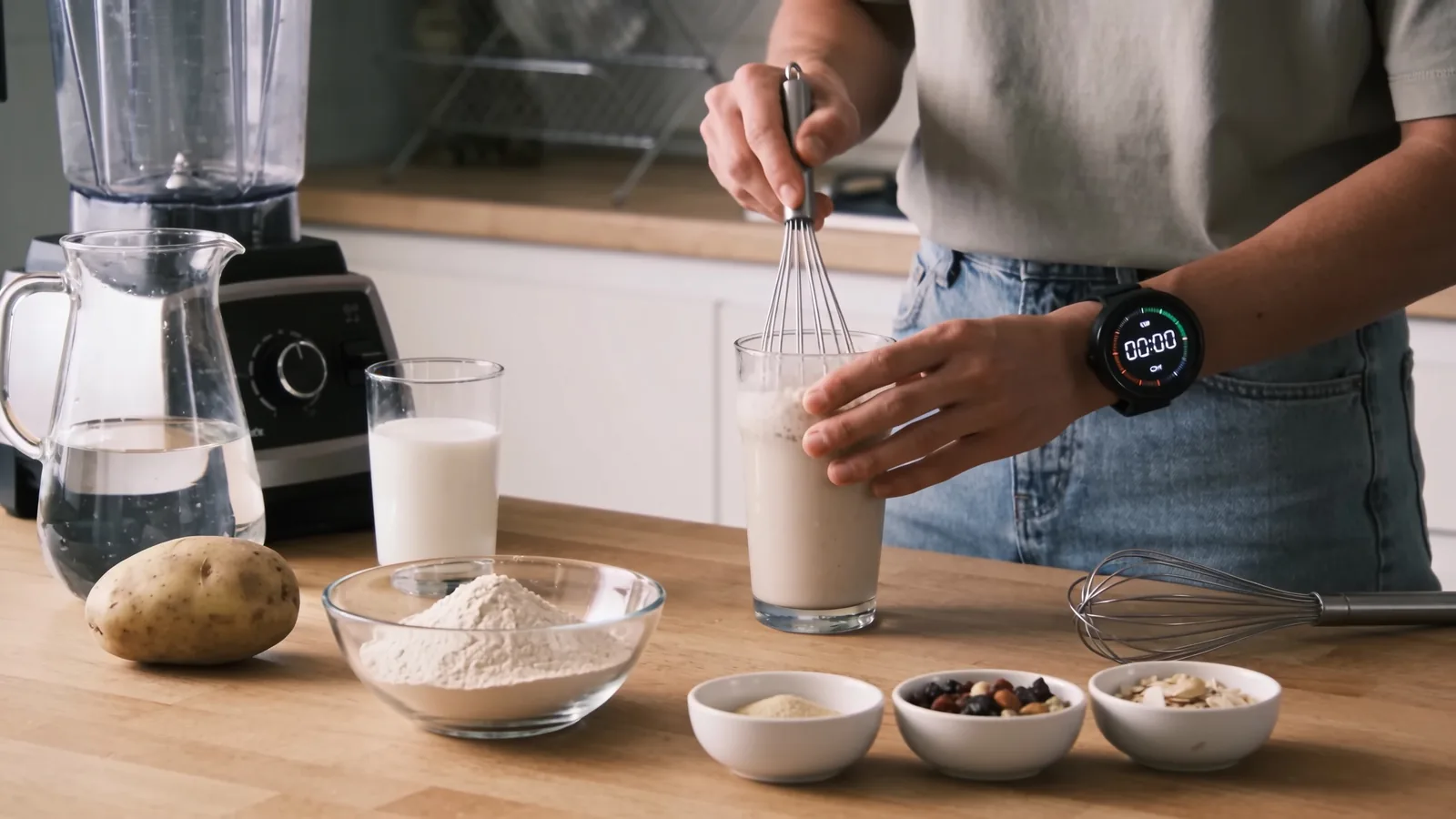
Pour your 8–12 ounces of cold liquid in first, then add the scoop on top of the liquid. The powder begins hydrating from the surface down before you ever agitate it. If you are using a shaker bottle, add the wire whisk ball or spring at this stage. Cold liquid is better than warm here: warmth makes some proteins aggregate faster, which encourages clumps rather than dissolving them.
If you are mixing more than one scoop, scale the liquid with it — roughly 8 ounces of liquid per 25-gram scoop. Stacking two scoops into the same small volume of water is a common cause of a thick, pasty shake that never fully smooths out. The powder needs enough water to hydrate every particle; short it on liquid and even perfect technique leaves grit at the bottom of the glass.
Step 4 — Blend or shake for 20–30 seconds
Agitation is what disperses the particles and breaks up any clusters. A shaker bottle with a whisk ball is enough for a water or juice shake — shake hard for a full 20 to 30 seconds, not the two casual flicks most people give it. Count it out; under-mixing is the most common reason a shake comes out chalky.
For thicker shakes, milk-based blends, or anything with fruit, a blender does a more thorough job and aerates the drink slightly, which improves mouthfeel. A handheld immersion blender works well for a single serving and is easier to rinse out than a full countertop blender. Whichever tool you use, the goal is the same: no visible dry specks and no grit settling at the bottom of the glass.
Step 5 — Let it hydrate before drinking
This is the step almost everyone skips. Even after thorough mixing, an unflavored isolate keeps improving for a couple of minutes as the protein fully absorbs liquid. Drinking it the instant you stop shaking is what leaves that dry, chalky coating on the tongue.
Let the shake rest two to three minutes, then give it one more brief shake or stir before drinking. The texture shifts noticeably from gritty to smooth, and any micro-clumps soften. If you make the shake in advance and refrigerate it, the texture holds up well — potato protein does not gel at fridge temperature the way some thickeners do — though you may want to stir it once before drinking. Persistent grittiness despite resting usually points back to too little liquid or under-shaking, both covered in common protein problems.
Step 6 — Recipe: the basic water shake
This is the minimalist version, and it is the one to master first.
| Ingredient | Amount |
|---|---|
| Unflavored potato protein isolate | 25g (1 scoop) |
| Cold water | 8–10 oz |
| Ice (optional) | 2–3 cubes |
Source: serving size based on Oikawa et al., Nutrients (2020).
Pour the water into the shaker, add the scoop, drop in the whisk ball, and shake hard for 30 seconds. Add ice if you want it colder and slightly more diluted. Rest two minutes, shake once more, and drink. It is also the cheapest to make and the easiest to rinse out afterward — there is nothing in it but protein and water. If you find the earthy note too forward, a squeeze of lemon both brightens the flavor and uses the acid solubility to your advantage.
Step 7 — Recipe: the citrus shake
This recipe leans directly on potato protein’s solubility at low pH.
| Ingredient | Amount |
|---|---|
| Unflavored potato protein isolate | 25g (1 scoop) |
| Cold orange or grapefruit juice | 8 oz |
| Water | 2 oz |
| Ice | 3–4 cubes |
Source: acid-solubility basis, Journal of Agricultural and Food Chemistry (2001).
Combine in a blender or shaker, liquid first. Because the protein dissolves in the acidic juice, the result is a bright, slightly tangy drink rather than a thick shake. Potato protein isolate contains all nine essential amino acids, so even in this lighter format you are getting a complete protein, not just calories. This is a good warm-weather option and a useful way to take protein for people who dislike creamy, milky shakes entirely.
Step 8 — Recipe: the fruit-and-milk smoothie
When you want something more filling — a breakfast or a meal stand-in — build it on milk and fruit.
| Ingredient | Amount |
|---|---|
| Unflavored potato protein isolate | 25g (1 scoop) |
| Milk (dairy or plant) | 10 oz |
| Frozen banana | 1 |
| Nut or seed butter (optional) | 1 tbsp |
Source: serving size based on Oikawa et al., Nutrients (2020).
Blend everything for 30–45 seconds until smooth. The frozen banana adds body and sweetness and is particularly good at covering the earthy flavor of an unflavored isolate; the milk and nut butter add fat that improves texture and satiety. To build this into a higher-calorie meal — adding oats, more fruit, or extra fat — the framework in how to make a 1000-calorie protein shake scales it up sensibly. For more combinations, browse the recipe index.
Step 9 — Know when to drink it
Total daily protein matters more than precise timing, but a few windows are especially practical. After training is a reasonable time to take a 25g dose, which falls in the range studied for muscle protein synthesis; see how much protein after a workout is optimal. Breakfast is another, since most people under-eat protein in the morning and a shake is fast.
Spreading intake across the day — rather than front-loading or back-loading it — keeps each serving in a useful range. The 2020 Nutrients study used two 25g servings daily. Potato protein is also a low-FODMAP protein source (Monash University FODMAP, 2019), which makes a shake easier to tolerate for people who find lactose-heavy whey concentrates uncomfortable. If digestion is your concern, the shake’s simplicity is the point: one ingredient, nothing else to react to.