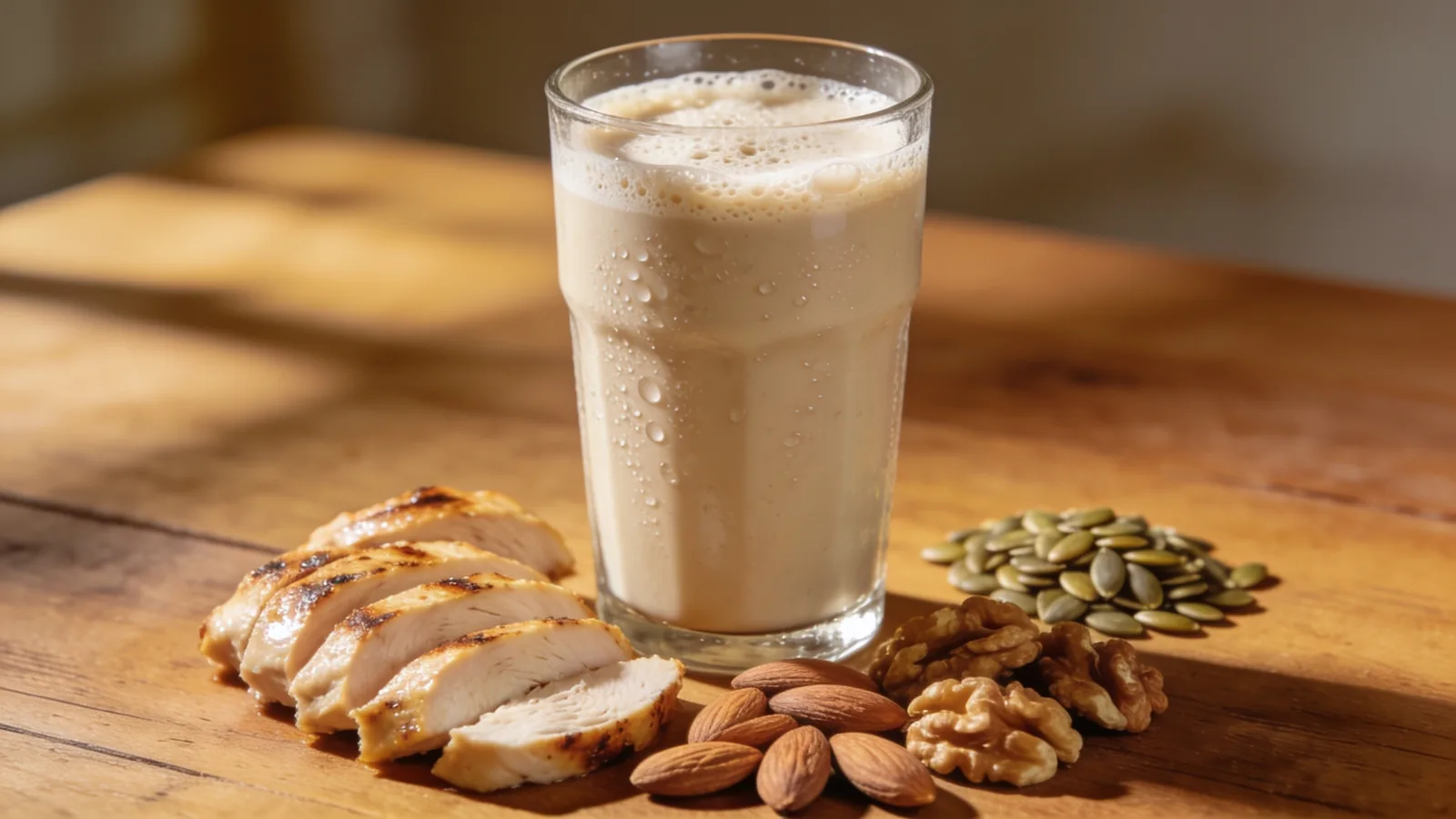
How to make a 1000-calorie protein shake at home: blend a calorie-dense liquid base, two scoops of protein powder, a slow-digesting carbohydrate, a fat source, and fruit. Done correctly, you reach roughly 1,000 calories and 60 grams of protein from real food — without a bag of pre-mixed mass gainer and its sugar load. The build below uses six ingredients and one blender.
To make a 1,000-calorie protein shake at home, blend 2 cups of whole milk (or fortified plant milk), 2 scoops of protein powder (about 40g protein), 1 cup of rolled oats, 2 tablespoons of nut butter, 1 banana, and 1 tablespoon of oil. This combination lands near 1,000 calories and 60–70g of protein. Adjust oats and oil up or down by a tablespoon to fine-tune the total.
A balanced 1,000-calorie shake that drinks like a meal, not a dessert — high in protein, dense in calories, and built from ingredients you can pronounce. What you need: Blender · Protein powder · Whole milk or plant milk · Rolled oats · Nut butter · Banana · Oil · Time: 10 min
Steps to Build a 1,000-Calorie Protein Shake
The logic of a calorie-dense shake is simple: liquid for volume, protein for muscle repair, carbohydrate and fat for the calorie total. Most store-bought mass gainers hit their number with maltodextrin and added sugar. You can hit the same total with oats, fruit, and nut butter, and end up with far more fiber. Each step below tells you what to add and roughly what it contributes.
Pour the calorie-dense liquid base
Start with 2 cups of whole milk. Whole milk carries roughly 300 calories and 16 grams of protein across two cups, which does a lot of the heavy lifting before you add anything else. For a dairy-free build, use a fortified pea or oat milk with comparable calories — read the carton, because unsweetened almond milk has almost none.
Tip: If your goal is the highest protein per calorie rather than maximum mass, water as a base lets you control every calorie yourself. See protein with water vs milk for the trade-off.
Add two scoops of protein powder
Two scoops of a concentrated protein isolate add about 40 grams of protein. A potato protein isolate sits at 80–95% protein on a dry basis, so almost every gram in the scoop is protein rather than filler. In a 2020 trial published in Nutrients, 25 grams of potato protein isolate twice daily stimulated muscle protein synthesis in young women (PMID:32349353). Whey isolate, at 90–95% protein and under 1% lactose, works equally well if you tolerate dairy.
Leucine is the primary amino acid trigger for muscle protein synthesis, so the protein source matters more than the raw gram count when the shake is built for recovery. If you are drinking this around training, a complete protein with adequate leucine is the point.
Layer in a slow-digesting carbohydrate
Add 1 cup of rolled oats — roughly 300 calories and 10 grams of protein, plus fiber that slows digestion so the shake sits like a meal instead of a sugar spike. Oats are the workhorse of a homemade mass gainer: cheap, filling, and easy to blend smooth. If a full cup feels heavy, start with three-quarters of a cup and add the rest once you know your tolerance.
Pitfall: Skipping the carbohydrate and pushing the calories up with extra fat alone makes a shake that is hard to finish and slow to leave your stomach. Carbohydrate is what keeps a 1,000-calorie drink palatable.
Build calorie density with fat
Add 2 tablespoons of nut butter (about 190 calories and 8 grams of protein) and 1 tablespoon of oil (about 120 calories). Fat is the most efficient way to raise the calorie total without adding much volume — exactly what you want when the goal is to drink a meal’s worth of energy. Olive oil or a neutral avocado oil blends invisibly; the nut butter adds flavor and a little extra protein.
This is the lever to pull when you need more calories. Up the oil by a tablespoon to add roughly 120 calories at a time, without making the shake noticeably bigger.
Add fruit and blend
Drop in 1 banana (about 105 calories) for sweetness, potassium, and body. Frozen banana also chills the shake without watering it down the way ice does. Blend on high for 45–60 seconds until the oats are fully broken down and the texture is smooth. A high-supported blender matters here — under-blended oats leave a gritty shake.
Tip: For other ways to thicken a shake without diluting it, frozen cauliflower or half an avocado folds in cleanly and adds almost no detectable flavor.
Check the total and adjust
The build above lands near 1,000 calories and 60–70 grams of protein. If you came in under, add a tablespoon of oil or a second tablespoon of nut butter. If you came in over, drop the oats to three-quarters of a cup. Splitting a 1,000-calorie shake into two servings across the day is often easier on digestion than drinking it in one sitting — and there is reason to think it may be the better approach for muscle.
Research on protein distribution suggests that adding extra calories after a protein-containing meal does not extend the window of muscle protein synthesis in anabolic-resistant situations such as aging (PMID:30934871). In plain terms: a single enormous shake is not magically more anabolic than two moderate ones. If you are weight-gaining, the daily total is what counts. For the full picture on training nutrition, see our protein for athletes guide.
Approximate Macros
Exact numbers depend on your protein brand and milk, but here is the rough breakdown for the base build:
- 2 cups whole milk — ~300 cal, 16g protein
- 2 scoops protein isolate — ~120 cal, 40g protein
- 1 cup rolled oats — ~300 cal, 10g protein
- 2 tbsp nut butter — ~190 cal, 8g protein
- 1 banana — ~105 cal, 1g protein
- 1 tbsp oil — ~120 cal
- Total: ~1,135 cal, ~75g protein — trim oats to three-quarters cup to land near 1,000
If your aim is mass and muscle rather than a one-off big shake, the same principles scale across a day. Our notes on gaining weight and muscle with protein and whether mass gainers are worth it cover the strategy behind the recipe.