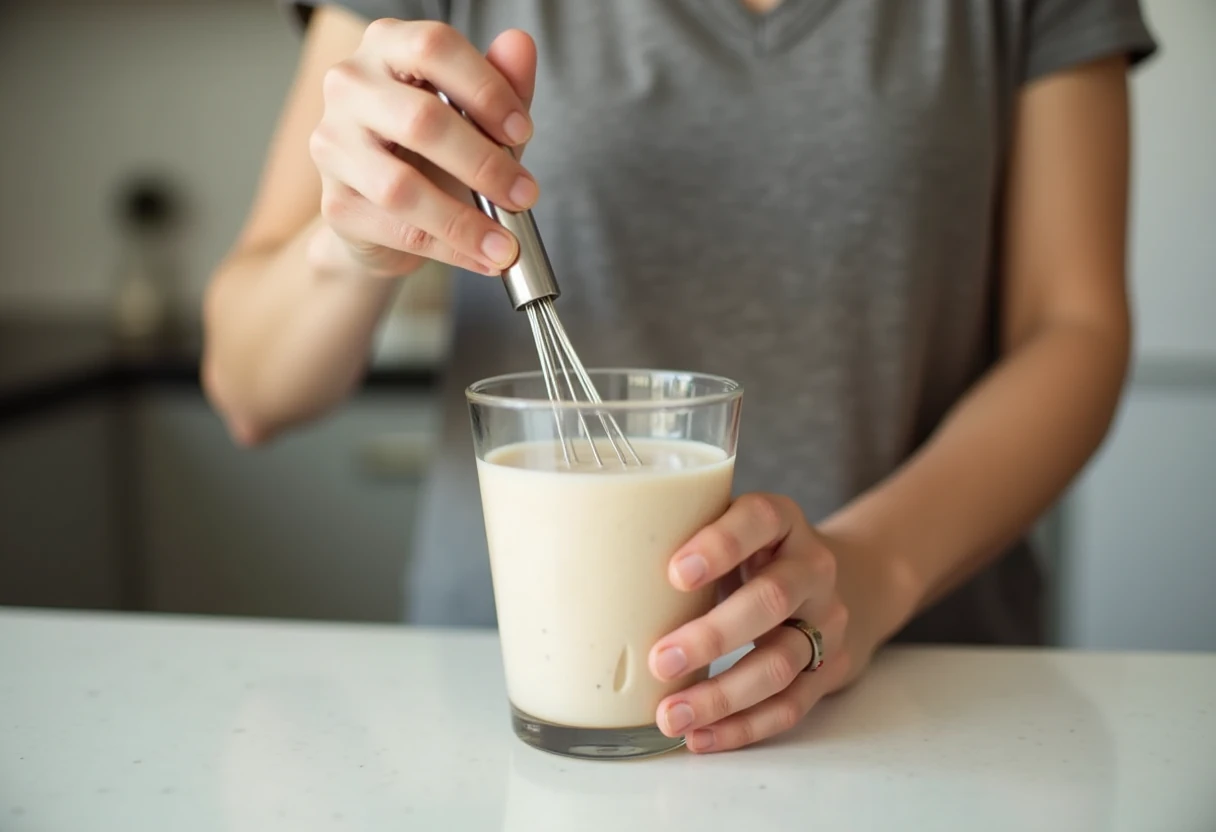
You scooped the powder, added water, shook for thirty seconds, and still ended up with a chalky film on top and a wet clump stuck to the bottom of the shaker. A protein powder that mixes with water should not require an apology or a fork. The clumping is not your fault, and it is almost always fixable — usually without buying anything new.
Protein powder clumps in water because the outer layer of each particle hydrates instantly, forming a gel skin that seals dry powder inside before it can dissolve. The fix is mechanical, not magical: add water to the shaker first, then powder, use a shaker ball or frother, and choose a fine-milled isolate over a coarse concentrate. Isolates with 80–95% protein and minimal added gums disperse most reliably in plain water.
- Reverse the order: water in the shaker first, powder second. This alone solves most clumping.
- Add agitation: a wire shaker ball, an electric milk frother, or a five-second blend breaks the gel skin.
- Match the powder to water: fine-milled isolates and instantized (lecithin-treated) powders disperse far better than coarse concentrates.
- Mind the temperature: ice-cold water slows dissolving; room-temperature or slightly warm water mixes faster.
Clumping is one of the most common complaints in our inbox, and it sits near the top of nearly every list of common protein problems. Before you blame the product, it helps to understand why the lumps form in the first place — because the mechanism tells you exactly which fix to reach for.
Reverse the order: water first, powder second
This is the cheapest and most effective change you can make. When you drop powder into an empty cup and then pour water on top, the water hits a dense pile and only wets the outside. Each particle’s surface hydrates in milliseconds and swells into a gel, and that gel seals the still-dry powder underneath. You get a clump with a soft skin and a dry core — the classic shaker-bottom lump.
Pour your water into the shaker first, add the powder on top, then seal and shake. The grains disperse through the liquid before they have a chance to clump together. If you are using a blender or a jar, the same rule applies: liquid in, powder after. No new equipment, no new product — just a different order of operations.
Add real agitation — a ball, a frother, or five seconds in a blender
Wrist-shaking a sealed bottle moves the liquid but not always the powder trapped at the base. A wire shaker ball (the spring-coil kind) cuts through clumps as the liquid moves, which is why most decent shaker bottles ship with one. If yours went missing, a stainless whisk ball replaces it for a couple of dollars.
For powders that resist a shaker entirely — many coarse plant concentrates do — a handheld electric milk frother is the quiet hero. Ten seconds in the glass and the lumps are gone. A countertop blender does the same job in five seconds and aerates the drink slightly, which some people prefer. None of these require switching brands; they just supply the shear force that a lazy shake does not.
Choose a powder built to disperse in water
Not all powders are engineered the same way, and this is where the product genuinely matters. Three traits predict whether a powder mixes smoothly in plain water:
Isolate vs concentrate. Isolates are processed to a higher protein percentage — potato protein isolate runs roughly 80–95% protein on a dry basis, and whey protein isolate is 90–95% protein with under 1% lactose. The lower fat and carbohydrate content means fewer components to gum up. Concentrates carry more residual carbohydrate and fat, which tend to bind into pastier clumps in water alone. A techno-functional analysis of commercial plant protein powders confirmed that solubility and dispersibility vary widely between products even within the same protein type (Food Science & Nutrition, 2023, PMID:37509897).
Particle size. Finely milled powder has more surface area and disperses faster. Coarse, sandy powders settle and resist wetting.
Instantizing. Many powders that “mix instantly” are treated with sunflower or soy lecithin, which lowers surface tension so water penetrates each particle instead of beading off. It works well. The trade-off is an added ingredient — relevant if you read labels by default or are avoiding soy. If a powder lists only the protein and nothing else, it will rely more on your technique. That is the honest trade.
If you are still shopping, our best protein powder guide breaks down isolate versus concentrate and what each label term actually means.
Fix the temperature and the liquid
Cold water dissolves powder slowly. Surface tension is higher and the proteins hydrate sluggishly, so ice water plus a quick shake is a recipe for grit. You do not need hot water — room-temperature water mixes noticeably faster, and slightly warm water faster still. Mix first, then add ice if you want it cold.
Water is also the hardest medium to mix into, because it has none of the fat or thickness that helps milk or a smoothie carry powder. If a powder simply will not behave in water, a splash of milk, a few ounces of juice, or blending it into oats or yogurt sidesteps the problem entirely. That is not a workaround so much as a different use case — and for some powders, the better one.
A single-ingredient isolate, mixed correctly
Potato protein isolate is also worth a look for reasons beyond the shaker. It is a low-FODMAP protein source (Monash University, 2019), it carries no dairy, egg, soy, or nut allergens, and a 2020 trial found that 25g of potato protein isolate taken twice daily increased muscle protein synthesis rates in young women (Nutrients, 2020, PMID:32349353). If you want the background on how it is made and where it comes from, start with what is potato protein. We do not claim it mixes more easily than a lecithin-treated powder — it does not. We claim you can read the entire label without squinting, and that the smoothness is in your hands, not in an additive list.