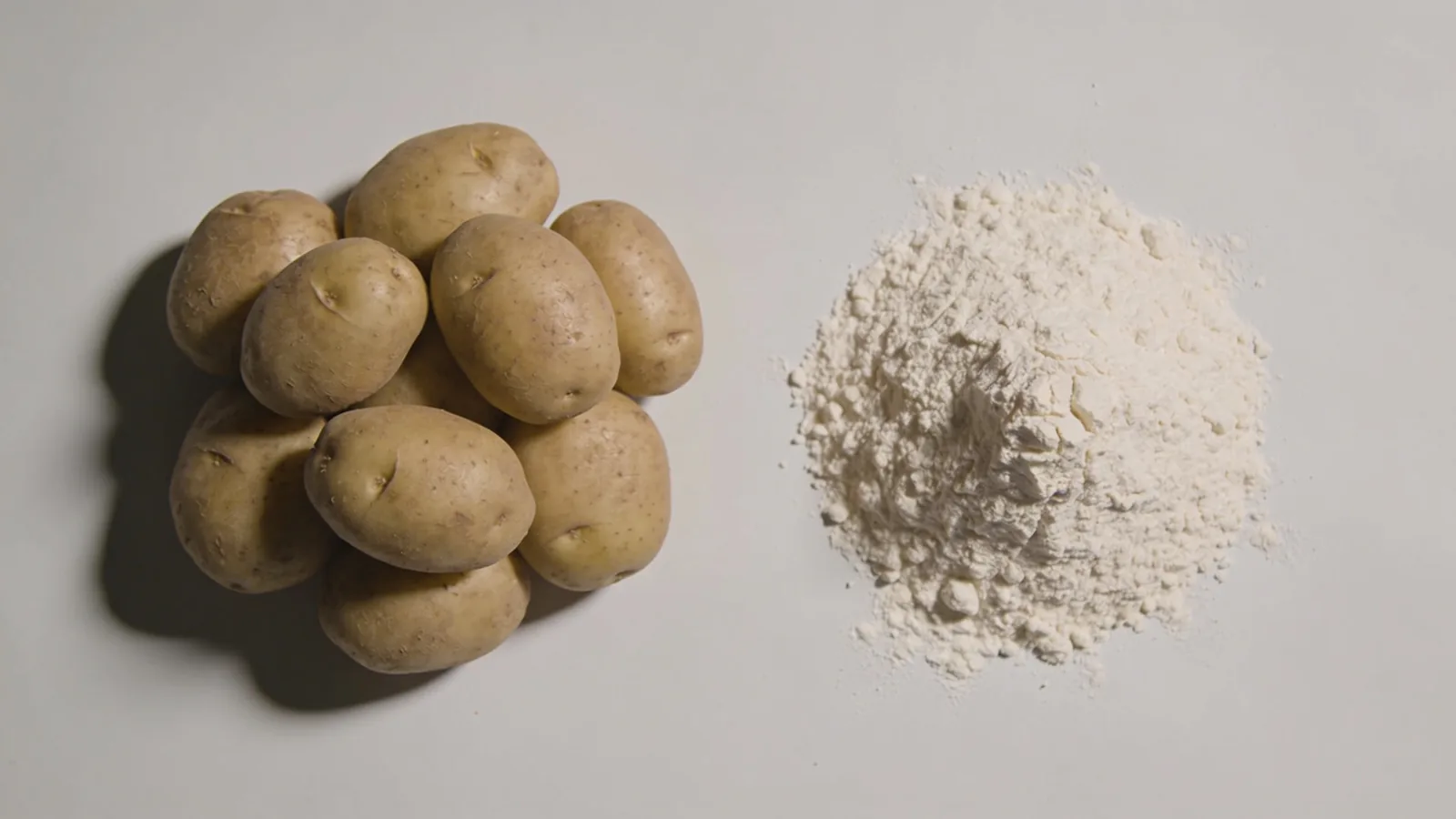
The central question in potato protein vs casein comes down to two variables: where the protein comes from and how quickly your body digests it. Casein is one of the two main proteins in cow’s milk and the slowest-digesting common protein source. Potato protein isolate is a plant protein extracted from potato fruit juice — a byproduct of starch production — and it carries no dairy, soy, egg, gluten, or nut content. If you are choosing between them, you are really choosing between a slow-release dairy protein and an allergen-free plant alternative.
Both are complete proteins. Both supply all nine essential amino acids. The differences that matter are digestion speed, allergen status, protein-quality scores, and how each one behaves over the hours after you drink it.
Potato Protein vs Casein: The Quick Comparison
Casein wins on raw protein-quality score and slow-release behavior. Potato protein wins on allergen safety and digestive tolerance. Neither is universally “better” — the right choice depends on whether you need a dairy-free protein or a slow overnight amino acid drip.
| Attribute | Potato Protein Isolate | Casein |
|---|---|---|
| Source | Plant (potato fruit juice) | Dairy (cow’s milk) |
| Digestion speed | Conventional rate | Slowest of common proteins |
| Slow-release behavior | No prolonged release | Gels in stomach, releases over hours |
| DIAAS | ≈100% | ≈115% |
| PDCAAS | 0.92–1.00 | 1.00 |
| Dairy / lactose | None | Dairy protein |
| Big 8 allergen | No | Yes (milk) |
| FODMAP status | Low-FODMAP | Varies; can contain lactose |
| Protein content | 80–95% (isolate) | High |
Source notes: DIAAS classifies both casein and potato as excellent-quality proteins, with casein’s DIAAS reported around 115% and potato’s reported as high as 100% (Herreman et al., Food Science & Nutrition, 2020, PMID:33133540); PDCAAS truncates to a maximum of 1.00, so casein scores 1.00 and potato 0.92–1.00 (Schaafsma, J Nutr, 2000, PMID:10867064); low-FODMAP status (Monash University, 2019).
How Digestion Speed Differs
Casein is the slowest-digesting common protein, and that is its defining trait. When you drink casein, it forms a gel-like clot in the acidic environment of the stomach. That clot slows gastric emptying, so amino acids trickle into the bloodstream gradually over several hours rather than arriving all at once. Researchers describe this as a “slow” protein, in contrast to “fast” proteins like whey, and the speed of amino acid absorption measurably changes postprandial protein synthesis, breakdown, and deposition (Boirie et al., Proc Natl Acad Sci USA, 1997, PMID:9405716).
Potato protein isolate does not behave this way. It does not form the same gastric clot, so it digests and absorbs at a more conventional rate — closer to the middle of the spectrum than to either casein’s slow curve or whey’s rapid spike. For most everyday uses — a shake after training, a scoop stirred into oatmeal, a protein top-up at breakfast — that conventional rate is exactly what you want. The slow-release property only becomes relevant when prolonged, sustained amino acid delivery is the specific goal, which is why casein is traditionally taken before sleep.
This is the honest trade-off: if you specifically value casein because of its overnight slow-release behavior, potato protein is not an identical substitute. It is a complete protein you can use at any time of day, but it will not replicate casein’s multi-hour drip. For a faster-digesting comparison, see potato protein vs whey, where the digestion-speed gap runs in the opposite direction.
Protein Quality: DIAAS and PDCAAS
Casein scores higher than potato protein on protein-quality metrics, but both clear the bar for high-quality complete protein. Casein’s DIAAS has been reported around 115% — among the highest of any protein — and casein, potato, egg, and pork are all classified as excellent-quality proteins with a DIAAS above 100 (Herreman et al., Food Science & Nutrition, 2020, PMID:33133540). Potato protein isolate’s DIAAS has been reported as high as 100%, with a PDCAAS in the 0.92–1.00 range.
A short primer on the difference: PDCAAS truncates any score above 1.00 down to 1.00, which compresses the top of the scale and makes several high-quality proteins look identical (Schaafsma, J Nutr, 2000, PMID:10867064). DIAAS does not truncate, so it can show values above 100 and better distinguishes proteins at the high end. This is why casein’s DIAAS can look larger than potato’s, even though both are complete — the metric simply has more room to separate them. If you want the full breakdown of how these scores work, read DIAAS vs PDCAAS and is potato protein high quality.
The practical takeaway: casein’s higher quality score reflects a denser essential-amino-acid load, but potato protein still delivers all nine essential amino acids in amounts sufficient to support muscle protein synthesis. The gap on paper is larger than the gap in real-world outcomes for most people meeting their daily protein target.
What the Muscle-Building Research Shows
Both proteins stimulate muscle protein synthesis, with the strongest direct evidence sitting on different sides of the comparison. For casein, the relevant context is its digestion speed. In older men, whey stimulated postprandial muscle protein accretion more effectively than casein and casein hydrolysate, an effect attributed to whey’s faster digestion and higher leucine content (Pennings et al., Am J Clin Nutr, 2011, PMID:21367943). A separate study found whey stimulated post-exercise mixed muscle protein synthesis more than casein or soy, again on the basis of faster absorption kinetics (Tang et al., J Appl Physiol, 2009, PMID:19589961). In other words, casein’s slow release is an advantage for sustained delivery but a modest disadvantage for the acute spike that drives the post-workout response.
For potato protein, the headline study is direct: consumption of 25g of potato protein isolate twice daily stimulated muscle protein synthesis rates at rest and after resistance exercise in young women, demonstrating its anabolic properties (Oikawa et al., Nutrients, 2020, PMID:32349353). That trial is the reason potato protein is now described as a high-quality plant protein rather than a second-tier option.
One mechanistic note worth honesty about: a dairy-protein-rich meal acutely stimulated mTOR and ribosomal protein S6 phosphorylation — key anabolic signaling steps — whereas a soy-protein-rich meal did not, in middle-aged men (Gran et al., Nutrition & Metabolism, 2014, PMID:25302072). The research base directly comparing potato protein to casein head-to-head on muscle outcomes does not yet exist, so claims of exact equivalence would overstate the evidence. What the data supports is that both are effective; casein has the longer track record, and potato has a strong, specific clinical result behind it. The broader science is collected in our pillar on what potato protein is.
Allergen and Digestive Comfort
This is where potato protein has its clearest advantage. Casein is a dairy protein, which means it is unsuitable for anyone with a milk allergy, and it can carry lactose depending on the product. Potato protein isolate sits entirely outside the FDA’s Big 8 allergens — milk, eggs, fish, shellfish, tree nuts, peanuts, wheat, and soybeans. For the allergy parent whose child cannot have dairy, or the adult tracking down every possible reactive input, a single-ingredient potato protein removes dairy from the equation completely.
Potato protein is also a low-FODMAP source (Monash University, 2019), with no lactose, which makes it gentler for people who get bloating or discomfort from dairy proteins. If digestive tolerance is your reason for leaving whey or casein behind, this is a meaningful difference rather than a marketing claim. Our guide to dairy-free protein and the allergen-free protein overview cover the topic in depth.
One caveat stated plainly: potato protein is not allergen-free for everyone. If you have a diagnosed potato allergy, you should not consume it — patatin and a 53kDa protein have been identified as potato’s allergenic components. But potato allergy is uncommon, and potato is not among the major declared allergens, which is why it is positioned as an allergy-safe substitute for the proteins most people react to. People weighing dairy specifically may also want our note on whether whey causes inflammation like dairy.
Which Should You Choose?
Choose casein if its slow-release behavior is the specific feature you want — for example, a pre-sleep protein meant to supply amino acids through the night — and you tolerate dairy without issue. Casein’s higher DIAAS and long research history are real, and there is no reason to talk you out of a protein that works for you.
Choose potato protein isolate if you need to avoid dairy, lactose, soy, egg, gluten, or nuts; if dairy proteins leave you bloated; or if you simply prefer the shortest possible ingredient list. It disappears into food, mixes into shakes, and supplies a complete amino acid profile without a single Big 8 allergen.
For most people the deciding factor is not the muscle-building gap — it is dairy. If dairy is fine for you, casein is a strong choice with a slow-release edge. If dairy is a problem, potato protein gives you a complete protein without it. You can also compare both against other options in our best protein powder guide, or read up on how much leucine you need per day to hit the threshold that drives muscle synthesis regardless of which protein you pick.