A page titled “Potato Protein Side Effects: What to Know” practically promises a warning list. The honest version is shorter than most readers expect: potato protein isolate has one of the least troublesome digestive profiles of any protein on the shelf — no lactose, no legume sugars, and a rate of true allergy low enough that it is routinely marketed as an allergen-sparing ingredient.
The most common reported side effects of dairy and legume proteins — bloating and gas from lactose, raffinose, and other FODMAPs — largely do not apply to potato protein isolate, which contains none of those carbohydrates and is rated low-FODMAP by Monash University. True potato allergy exists but is rare, and people with a diagnosed potato allergy should avoid the isolate because the allergenic protein patatin can still be present. There are no established upper intake limits and no documented drug interactions.
Why Potato Protein Is Gentle on Digestion
Most protein-powder complaints trace back to a carbohydrate, not the protein itself. Whey concentrate carries lactose, the milk sugar that ferments in the gut of anyone lacking lactase. Pea and soy proteins carry residual galacto-oligosaccharides and raffinose-family sugars — the same compounds that make beans famous. These are short-chain fermentable carbohydrates, collectively labeled FODMAPs, and they are the usual cause of the gas and bloating people blame on “protein.”
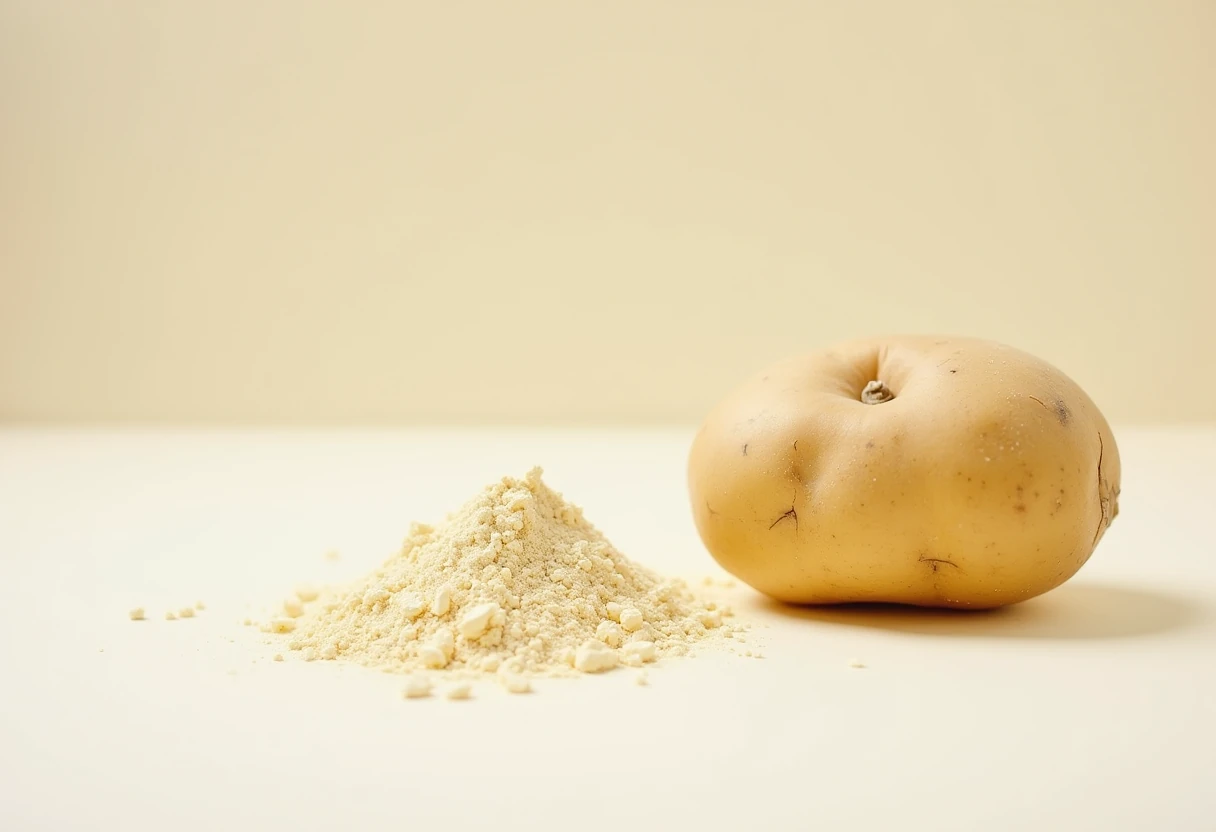
Potato protein isolate sidesteps the entire category. It is separated from potato fruit juice, a byproduct of starch manufacturing (Food and Bioprocess Technology, 2012), and the isolation process partitions the water-soluble carbohydrates away from the protein fraction. The finished isolate is 80–95% protein with no lactose and no legume oligosaccharides. Monash University, which maintains the reference database for fermentable carbohydrates, classifies potato protein as a low-FODMAP protein source. If you want the full picture of where the ingredient comes from, our explainer on how potato protein isolate is separated from the rest of the tuber covers the extraction step in detail.
Does Potato Protein Cause Bloating or Gas?
For most people, no. Bloating from protein powder is usually driven by lactose or fermentable oligosaccharides, and potato protein isolate contains neither. It is rated low-FODMAP by Monash University, which makes it a reasonable option for people with irritable bowel syndrome who react to whey concentrate, pea, or soy.
The contrast is clearest in a side-by-side comparison. Whey isolate is roughly 90–95% protein with under 1% lactose, while whey concentrate retains more (Monash University notes concentrate carries more of the FODMAP lactose than isolate). Pea and soy are legume proteins and bring along the oligosaccharides characteristic of beans.
| Protein source | Lactose | Fermentable oligosaccharides (FODMAPs) | Typical GI complaints | Major allergen class |
|---|---|---|---|---|
| Whey (concentrate) | Present | Lactose (a FODMAP) | Bloating, gas in lactose-intolerant users | Dairy |
| Whey (isolate) | <1% | Trace lactose | Mild, mostly in lactose-sensitive users | Dairy |
| Pea | None | Galacto-oligosaccharides | Gas, bloating in sensitive users | Legume |
| Soy | None | Raffinose, stachyose | Gas, bloating; FODMAP-sensitive reactions | Soy (major allergen) |
| Potato | None | None (low-FODMAP) | Minimal | Potato (rare) |
None of this makes potato protein magic. Any protein eaten in a single large bolus can feel heavy, and very high total-protein diets shift the gut microbiome regardless of source. But the specific, predictable triggers — lactose and legume sugars — are simply absent. For a broader troubleshooting guide, see our overview of common protein problems.
Is Potato Protein Safe If You Have Allergies?
For people without a potato allergy, yes — potato protein is one of the few proteins free of the eight major allergens (no dairy, egg, soy, nuts, wheat, fish, or shellfish), which is why a 2021 review in Food Research International describes it as a high-quality, allergy-free protein suitable for allergen-free formulations. People with a diagnosed potato allergy are the exception and should avoid it.
True potato allergy is uncommon. Where it does occur, the responsible proteins have been characterized: a 2018 murine model identified patatin and a 53 kDa protein as the principal potato allergens. Potato allergens are also heat-labile, losing reactivity when heated, which is one reason cooked potato is tolerated by some people who react to raw potato. Among people with a confirmed potato allergy, commonly associated conditions include asthma, allergic rhinoconjunctivitis, and atopic dermatitis.
An important distinction: a protein isolate is refined, not allergen-stripped. The Center for Research on Ingredient Safety (CRIS) at Michigan State University states plainly that if you have a potato allergy, you should not consume potato protein, because the allergen can still be present. If you react to potato, the isolate is not a workaround.
Cross-reactivity is a separate question that often gets tangled with latex-fruit syndrome. The protein families most often implicated in plant-food cross-reactions are PR-10 proteins, profilins, and lipid transfer proteins — these are not the patatin-type storage proteins that dominate isolate-grade potato protein. Sweet potato, which people sometimes assume is related, is botanically distinct and is not considered cross-reactive with latex. If allergen avoidance is your reason for being here, our allergen-free protein guide and our notes on protein for dairy intolerance go deeper.
A protein isolate is refined, not allergen-stripped. If you react to potato, the isolate is not a workaround.
Does Potato Protein Contain Oxalates?
Whole potatoes contain oxalates, but the isolate carries a negligible amount. Oxalates are water-soluble and concentrate in the watery fraction of the tuber, while the protein is separated out of that fraction during isolation. The result is a protein concentrate, not a whole-food powder — the soluble compounds that travel with potato flesh are largely left behind in the byproduct stream.
No quantified oxalate value has been published for commercial potato protein isolate specifically, but the mechanism indicates a negligible load: this is a refined protein extracted from potato fruit juice, not a serving of mashed potato. People managing oxalate intake for kidney-stone reasons should still discuss any new dietary staple with their clinician, but isolate-grade potato protein is not a meaningful oxalate load.
How Much Potato Protein Is Too Much?
There is no established upper limit for potato protein, and protein intake within the range used by active adults has not been shown to harm kidney function in healthy people. A 2018 systematic review and meta-analysis of 28 trials and 1,358 participants found no difference in glomerular filtration rate between higher- and lower-protein diets in healthy adults.
The kidney concern applies to a specific population: people with pre-existing chronic kidney disease. The NIDDK-funded Modification of Diet in Renal Disease (MDRD) Study tested protein restriction (down to 0.58 and 0.28 g/kg/day) in patients with already-reduced GFR. That research is about managing established disease, not preventing it — and it does not translate into a reason for healthy adults to limit protein. If you have diagnosed kidney disease, protein targets should be set with your nephrologist regardless of which protein you choose.
In practical terms, potato protein behaves like any complete protein. The clinical muscle-protein-synthesis work in young women used 25 g doses twice daily without reported tolerance problems. As with any protein, spreading intake across meals is easier on digestion than a single oversized serving.
Does Potato Protein Interact With Medications?
There are no documented drug interactions for potato protein isolate. It is a food-grade protein derived from a common food crop, and it does not contain the stimulants, herbal extracts, or high-dose micronutrients that drive most supplement-drug interactions.
The standard caveat for any protein-rich food applies: protein can affect the absorption timing of certain medications (for example, levodopa), and concentrated protein changes meal composition. If you take a drug with food-timing instructions, the interaction is with protein and meal timing generally, not with potato protein specifically. None of this is unique to this ingredient.
What We Don’t Know Yet
The safety case for potato protein is strong but not bottomless. Long-term human trials at high habitual intakes are limited; most clinical data come from acute and short-term muscle-protein-synthesis studies rather than year-long feeding trials. The effect of any high-protein diet on the gut microbiome varies by source and is still being mapped. And a published oxalate figure for the isolate specifically remains an open knowledge gap.
What the evidence does support is unambiguous: for the large majority of people, the predictable side-effect triggers found in dairy and legume proteins are absent here, and the rare risk — potato allergy — is identifiable and avoidable. For anyone weighing this against other options, our protein powder guide is the place to verify the rest.
References
- Devries MC, et al. Changes in kidney function do not differ between healthy adults consuming higher- compared with lower- or normal-protein diets: a systematic review and meta-analysis. The Journal of Nutrition (2018). PMID:30383278.
- Modification of Diet in Renal Disease (MDRD) Study Group. NIDDK Central Repository / NIH.
- Hussain M, et al. Potato protein: An emerging source of high quality and allergy free protein, and its possible future based products. Food Research International (2021). PMID:34507729.
- A murine model of wheat versus potato allergy: patatin and 53kDa protein are the potential allergen from potato. Molecular Immunology (2018). PMID:30031281.
- Monash University FODMAP. “Protein powders and IBS.” Monash FODMAP.
- Center for Research on Ingredient Safety (CRIS), Michigan State University. Statement on potato protein and potato allergy.
- Thermo Fisher Scientific / Phadia. ImmunoCAP Allergen Encyclopedia (f35 Potato).
- Oikawa SY, et al. Potato Protein Isolate Stimulates Muscle Protein Synthesis at Rest and with Resistance Exercise in Young Women. Nutrients (2020). PMID:32349353.