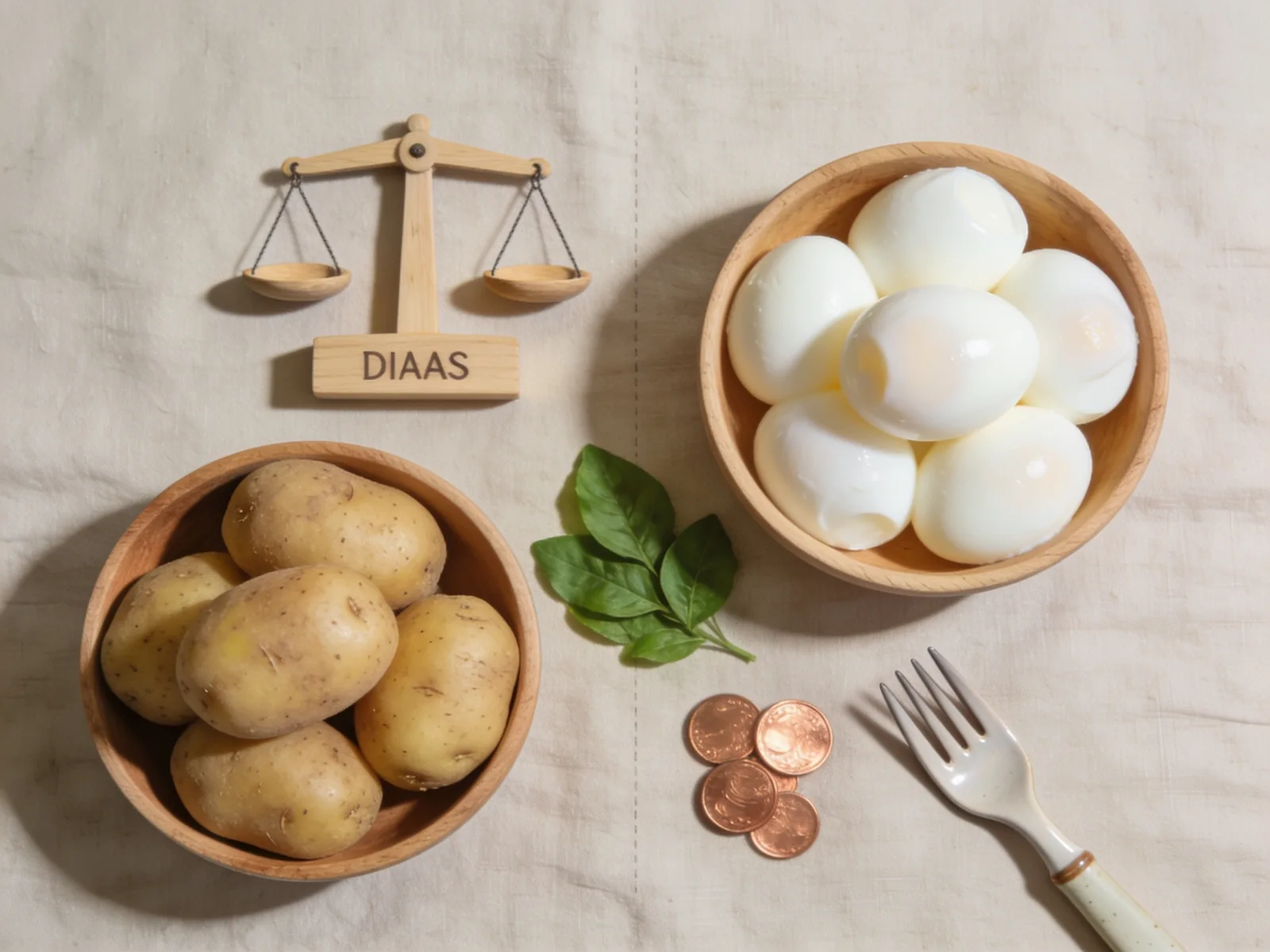
Potato protein vs egg white protein comes down to a single trade-off: egg white is the reference standard for protein quality, while potato protein isolate matches it closely without being one of FDA’s nine major allergens — including egg itself. Egg protein scores a PDCAAS of 1.00, the maximum (Schaafsma 2000). Potato protein isolate scores 0.92–1.00 on the same scale, placing it on par with several animal proteins.
That is the entire debate in two sentences. The rest of this guide explains the numbers behind it, where the two proteins genuinely differ, and which one belongs in your shaker depending on what you can and cannot eat.
The Verdict: Which Wins?
If your only criterion is protein quality measured by amino acid scoring, egg white wins narrowly. It is the benchmark every other protein is measured against, with a PDCAAS of 1.00 and a DIAAS generally above 100 — meaning it delivers a surplus of digestible essential amino acids relative to human requirements.
But “wins narrowly” is the operative phrase. Potato protein isolate sits a hair behind on PDCAAS and reaches a DIAAS as high as 100% (Herreman et al. 2020), which is functionally interchangeable for most people building or preserving muscle. And potato protein wins decisively on two factors egg white cannot touch: it is not a major allergen, and it is vegan. For anyone who avoids eggs by necessity or choice, the comparison stops being close.
So: egg white for raw amino acid scoring; potato protein for almost everyone navigating allergies, plant-based diets, or a preference for the fewest possible ingredients.
Potato Protein vs Egg: The Comparison Table
| Factor | Potato Protein Isolate | Egg White Protein |
|---|---|---|
| PDCAAS | 0.92–1.00 | 1.00 |
| DIAAS | As high as 100% | Generally >100% |
| Essential amino acids | All nine present; ~37% EAA | All nine present |
| One of FDA’s 9 major allergens | No | Yes (eggs) |
| Vegan-friendly | Yes | No |
| FODMAP level | Low-FODMAP | — |
| Typical protein content | 80–95% (dry basis) | Almost entirely protein |
| Saturated fat | — | None (egg white only) |
Sources: PDCAAS method from Schaafsma (Journal of Nutrition 2000); potato DIAAS from Herreman et al. (Food Science & Nutrition 2020); EAA composition from Amino Acids 2018 (PMID:30167963); allergen classification from FDA’s major allergen list; egg white composition from Cleveland Clinic Health Essentials 2025. Cells without a verified figure are marked with an em-dash.
Protein Quality: DIAAS and PDCAAS Explained
Protein quality scores answer one question: does this protein supply enough of every essential amino acid, in digestible form, to meet human needs? Two metrics dominate. PDCAAS is the older standard; DIAAS is the newer, more precise measure that accounts for digestibility at the end of the small intestine. We cover the distinction in depth in our guide to DIAAS vs PDCAAS.
Under the PDCAAS method, values higher than 100% are truncated to 100%, so the highest-quality proteins — including egg, milk, and other animal references — sit at that maximum (Schaafsma 2000). Egg is in that top tier by definition — it is the standard the scale was built around. Potato protein isolate scores 0.92–1.00, which means at the high end it is indistinguishable from egg, and at the low end it trails by a margin most people will never notice in practice.
DIAAS tells a similar story with finer resolution. Egg protein generally scores above 100%. Potato protein isolate has been reported as high as 100% (Herreman et al. 2020); in that same analysis, egg, casein, and potato proteins are classified as excellent-quality proteins with an average DIAAS above 100%, while whey and soy fall into the high-quality tier with a DIAAS of at least 75%. In other words, the newer, stricter metric does not open up a meaningful gap between potato and egg — potato sits in the same top tier. Plant proteins as a category usually score lower than animal proteins, which makes potato protein an outlier worth understanding. Our breakdown of whether potato protein is high quality walks through these scores in more detail.
Amino Acid Profiles: Where They Differ
Both proteins are complete: egg white and potato protein isolate each contain all nine essential amino acids. The difference is in concentration. Potato protein isolate is roughly 37% essential amino acids by composition, compared with 43% for whey protein isolate (Amino Acids 2018). Egg white sits among the high-EAA animal references.
Why does this matter? Essential amino acid density, and leucine in particular, drives the muscle protein synthesis signal. A protein with a lower EAA percentage can still hit the same anabolic threshold — you simply need a slightly larger serving to deliver the same absolute grams of leucine. This is the practical reality behind every plant-versus-animal protein comparison, and it is why serving size, not just the percentage on a spec sheet, determines results. For the mechanics, see our guide on how much leucine per day to build muscle.
There are also subtler compositional differences. In one comparative study, whey produced a larger insulin response than potato protein, with both plant proteins showing a lower insulinaemic response and improved glucose maintenance compared to whey (Nutrients 2021, PMID:34201703). That finding involved whey rather than egg, but it illustrates that amino acid profiles shape more than muscle signaling — they influence appetite and glycemic responses too.
Muscle Protein Synthesis: Does Potato Keep Up?
This is where potato protein earns its place beside egg. In a 2020 trial, young women who consumed 25 g of potato protein isolate twice daily increased their rate of muscle protein synthesis, while the placebo group did not (Oikawa et al., Nutrients 2020). The researchers concluded that potato protein isolate is a high-quality plant-based protein source that effectively stimulates muscle protein synthesis.
That is the key takeaway for anyone choosing a protein to build or preserve muscle: at an adequate serving size, potato protein isolate produces the anabolic response that protein scoring predicts. Egg white does the same — it has decades of research behind it as a complete, highly digestible protein. Neither is a compromise on results. The choice between them, for muscle purposes, reduces to tolerance, diet, and preference rather than effectiveness. If you are building muscle on a plant-based diet, our guide on building muscle on a vegan diet covers how to structure intake.
Allergens: The Decisive Difference
Here the two proteins separate completely. Eggs are one of FDA’s nine major food allergens, alongside milk, fish, shellfish, tree nuts, peanuts, wheat, soybeans, and sesame. Egg allergy is one of the most common in children. Potato protein is not on that list. It is consistently described in the literature as a high-quality, allergen-free protein source (Food Research International 2021), and it is recognized as Generally Recognized As Safe (GRAS) by the FDA.
For the allergy parent reading labels for a child who cannot have dairy, eggs, nuts, or soy, this is the entire decision. A single-ingredient potato protein isolate sidesteps every one of those triggers. For the autoimmune-aware adult minimizing inputs, the same logic holds: fewer things to react to. Our allergen-free protein guide lays out the full reasoning, and our piece on whether you can be allergic to protein shakes covers what to watch for.
One honest caveat: “allergen-free” does not mean “allergy-proof.” Potato allergy exists, though it is uncommon. A murine model identified patatin and a 53 kDa protein as the potential allergens in potato (Molecular Immunology 2018). The Center for Research on Ingredient Safety at Michigan State University is blunt about it: if you have a potato allergy, you should not consume potato protein, because the allergen is still present. For the overwhelming majority who are not allergic to potatoes, the practical allergen risk is far lower than with egg.
Digestion, FODMAPs, and Tolerance
Beyond classic allergy, there is everyday digestive comfort. Potato protein is classified as a low-FODMAP protein source by Monash University, which makes it a sensible option for people with IBS or general sensitivity to fermentable carbohydrates. Egg white is also low in FODMAPs and well tolerated by most, but it is off the table entirely for anyone with egg allergy or aversion. If gut symptoms drive your choice, our overview of protein powder and gut health is a useful companion.
Vegan-Friendliness, Cost, and Taste
Egg white protein is an animal product and is not vegan. Potato protein isolate is a non-animal protein extracted from potato fruit juice — a byproduct of starch production — which makes it suitable for plant-based and vegan diets. For a strict vegan, this single fact ends the comparison before quality scores even enter the conversation.
On taste and function, both proteins are relatively neutral, which is why egg white has long been a baking staple. Potato protein is recognized as an allergen-free and vegan option for replacing the foaming function of egg white, and it brings emulsification and gelation to baked goods as well. A well-processed isolate is close to flavorless — it disappears into food rather than announcing itself. On cost, prices vary by brand and processing, and we do not publish a verified figure here; both sit in a similar range relative to whey and other isolates.
Who Should Choose Which
Choose egg white protein if you tolerate eggs, eat animal products, and want the single highest-scoring reference protein with the longest research history. It is the benchmark for a reason.
Choose potato protein isolate if you avoid eggs for allergy, dietary, or ethical reasons; if you want a protein that is not one of FDA’s major allergens; if you keep a low-FODMAP or vegan diet; or if you simply prefer the fewest possible ingredients on the label. On protein quality, you give up almost nothing — potato protein isolate matches egg closely on both PDCAAS and DIAAS, contains all nine essential amino acids, and stimulates muscle protein synthesis at adequate serving sizes.