Hitting 100g of protein a day as a vegan takes roughly four anchored eating occasions, each delivering 20–30g, with a vegan protein powder for weight loss closing whatever gap whole foods leave behind. The arithmetic is the hard part, not the willpower: plant foods carry protein at lower density than meat or dairy, so the day has to be built deliberately rather than assembled by accident.
To hit 100g of protein a day as a vegan, divide the target across four eating occasions of about 25g each: a protein-dense breakfast, two whole-food meals built on legumes, soy, or seitan, and one shake. A vegan protein powder for weight loss is the most reliable way to close the gap, because a 20–25g scoop adds protein without adding many calories. Spreading intake across the day matters as much as the source, since plant proteins are lower in leucine and digest more slowly than whey.
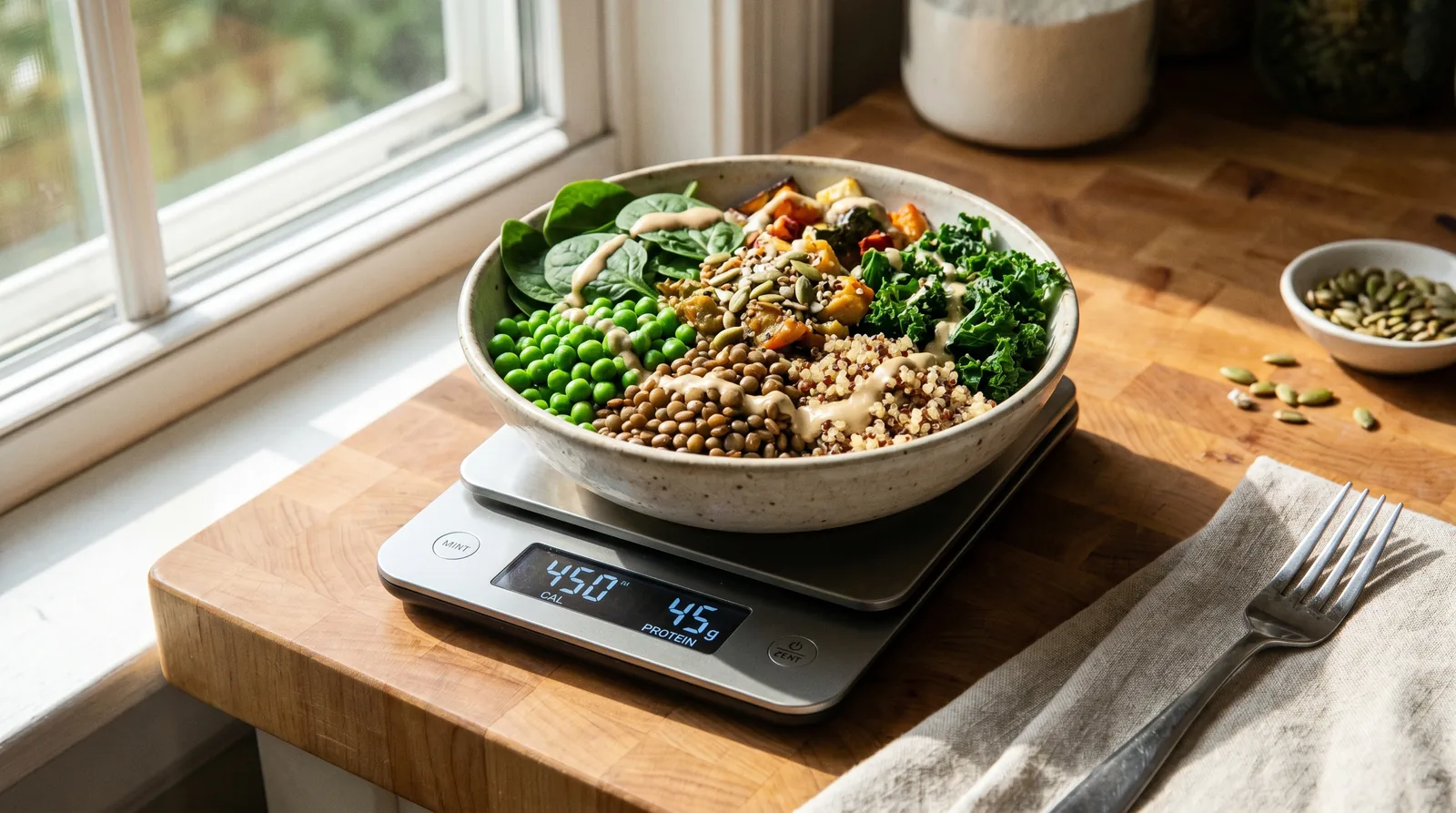
You can reach 100g of plant protein a day, on a calorie deficit, without spending the entire day eating — if you anchor each meal and let a single-ingredient powder do the closing work. What you need: A kitchen scale · A protein-tracking app · A minimal-ingredient vegan protein powder · Legumes, tofu, tempeh, or seitan · Time: 30 min to plan, then daily execution
How to Build Your Day to 100g
Protein has a measurable advantage for anyone eating at a deficit. It increases satiety and reduces subsequent energy intake more than carbohydrate or fat, an effect mediated by diet-induced thermogenesis and hormonal responses (PMID:18469287). High-protein meals also raise satiety and thermogenesis more than standard-protein meals (Journal of the American College of Nutrition, PMID:15466943). That is the entire case for prioritising protein during weight loss — you eat less overall and hold onto muscle while you do it. The deeper mechanics are covered in our pillar guide to protein for weight loss.
Set the real target, not a round number
100g is a useful headline, but check it against your body weight. Recommended intake for vegetarian and vegan athletes ranges from 1.3 to 1.7 grams per kilogram of body weight per day (The Whole U, University of Washington). During weight loss the higher end protects muscle while you eat less. A 65–75kg adult lands near 100g; below that weight you may target 85–95g.
Example: a 70kg person training a few times a week multiplies 70 × 1.4 = 98g. Round to 100. Work out yours with our walkthrough on how to calculate your daily protein target for weight loss.
Anchor breakfast at 25–30g
This is where most plant-based eaters quietly fail. Oats and fruit deliver maybe 8g; a coffee delivers nothing. Vegan athletes already tend to consume less protein than omnivores (Journal of the International Society of Sports Nutrition, PMID:28924423), and a thin breakfast sets the deficit for the whole day.
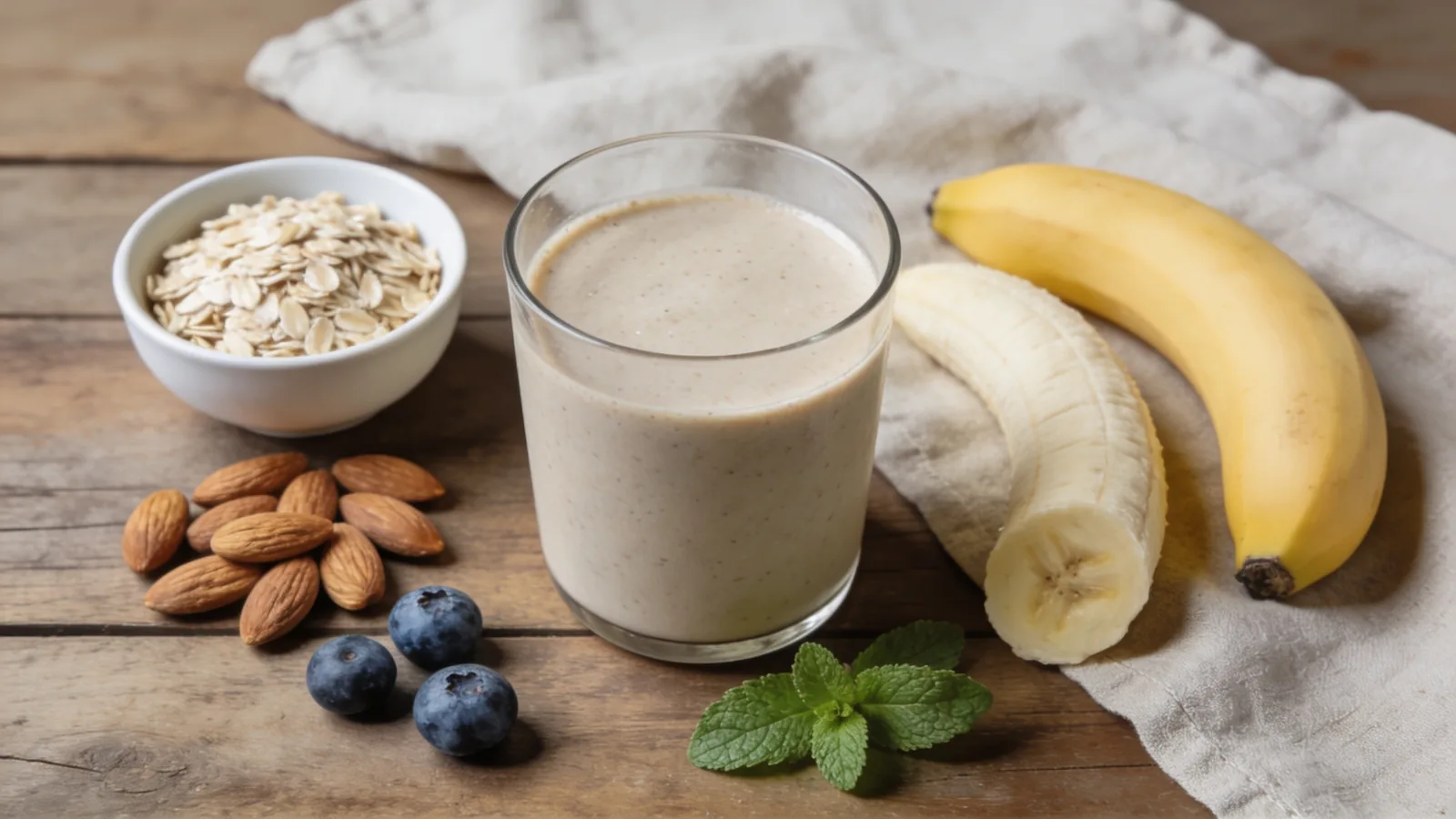
Example: 200g firm tofu scrambled with spinach (about 20g) plus a glass of soy milk (about 8g) clears 28g before 9am. If cooking is not happening, a shake does the same job in two minutes. See how to get 30g of protein at breakfast without eggs or dairy.
Build two whole-food meals on legumes, soy, or seitan
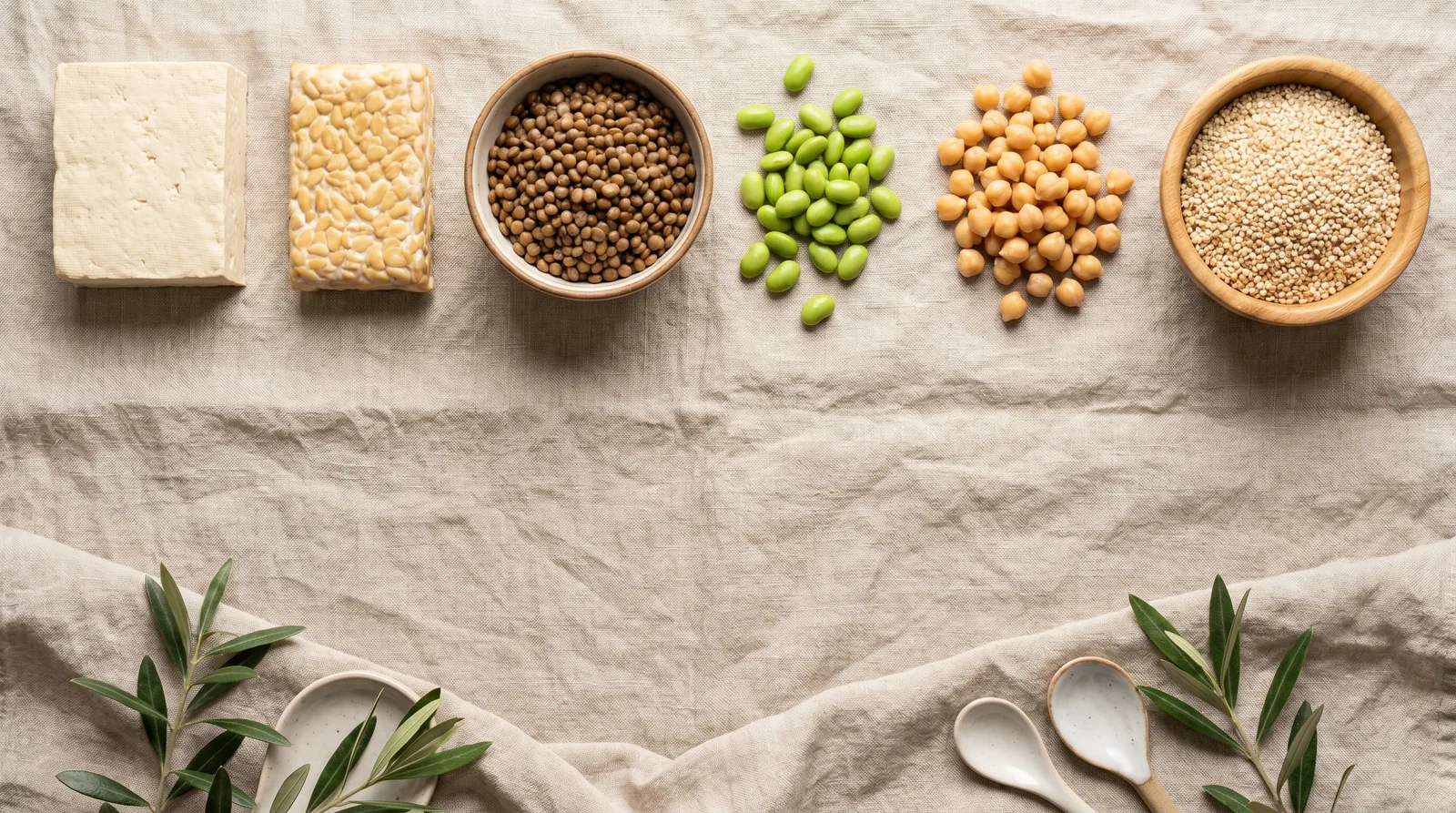
Two main meals at roughly 25g each cover half your target with real food. The Academy of Nutrition and Dietetics states that plant protein can meet requirements when a variety of plant foods is consumed and energy needs are met, and that an assortment eaten over a day provides all essential amino acids (Journal of the American Dietetic Association, PMID:19562864). You do not need to combine proteins at a single sitting — a day’s variety is enough.
Example: lunch of 200g cooked lentils over quinoa (about 26g); dinner of 150g tempeh stir-fry with edamame (about 30g). Pea protein is relatively low in the sulphur amino acids methionine and cysteine, so pairing legumes with grains across the day covers the gap. For the full pairing logic, read the best plant-based complete proteins and how to combine them.
Close the gap with a shake
After breakfast and two meals you are usually 20–25g short. A single scoop of vegan protein powder for weight loss closes that gap with minimal calories — most isolates deliver 20–25g protein for around 100 calories, which is why they suit a deficit better than another full meal. Multi-ingredient plant blends vary more, typically landing around 15–21g of protein per serving depending on formulation, so check the label rather than assuming a fixed dose.
Plant proteins do digest more slowly and carry less leucine than whey, which can make them less potent at stimulating muscle protein synthesis per gram (Current Developments in Nutrition, PMID:38846451). The practical fix is volume and timing: take the shake after training, and let total daily protein, not a single dose, do the work.
Choose a powder with the fewest ingredients and real testing
Heavy-metal contamination is the live problem in this category. Clean Label Project’s 2025 Protein Study 2.0 found that plant-based powders contained five times more cadmium than whey-based varieties. Consumer Reports’ 2025 testing of 23 products found that lead levels in plant-based products averaged nine times higher than dairy-based powders, with more than two-thirds exceeding the publication’s 0.5-microgram daily limit. A single-ingredient isolate with a published Certificate of Analysis removes the guesswork.
Tip: Potato protein isolate is a low-FODMAP protein source (Monash University FODMAP, 2019) and runs 80–95% protein on a dry basis, which makes it useful for sensitive stomachs. Background on the ingredient sits in What Is Potato Protein?
A 2020 trial found 25g of potato protein isolate twice daily stimulated muscle protein synthesis at rest and after resistance exercise in young women (Nutrients, PMID:32349353) — useful confirmation that a well-made plant isolate is not a downgrade for muscle retention during a cut.
Track for a week, then adjust
Log every gram for seven days. Most people discover they were 30–40g short of where they assumed. Protein status is assessed through nitrogen balance: a negative balance indicates a catabolic state and a positive balance an anabolic one, so the goal during weight loss is to stay neutral-to-positive even at a calorie deficit.
Pitfall: Do not lean on the shake for more than one of your four occasions. Whole foods bring fibre, micronutrients, and a slower release that keeps you full longer — the powder is the closer, not the backbone.
If you train, remember that protein alone does not build muscle; it has to be paired with resistance exercise to drive synthesis above breakdown over time (Sports Medicine, PMID:24791918).
Checklist
- Target set against body weight (1.3–1.7 g/kg)
- Breakfast hits 25–30g
- Two whole-food meals at ~25g each
- One shake closes the final 20–25g gap
- Powder is minimal-ingredient and third-party tested
- Logged for a full week and adjusted