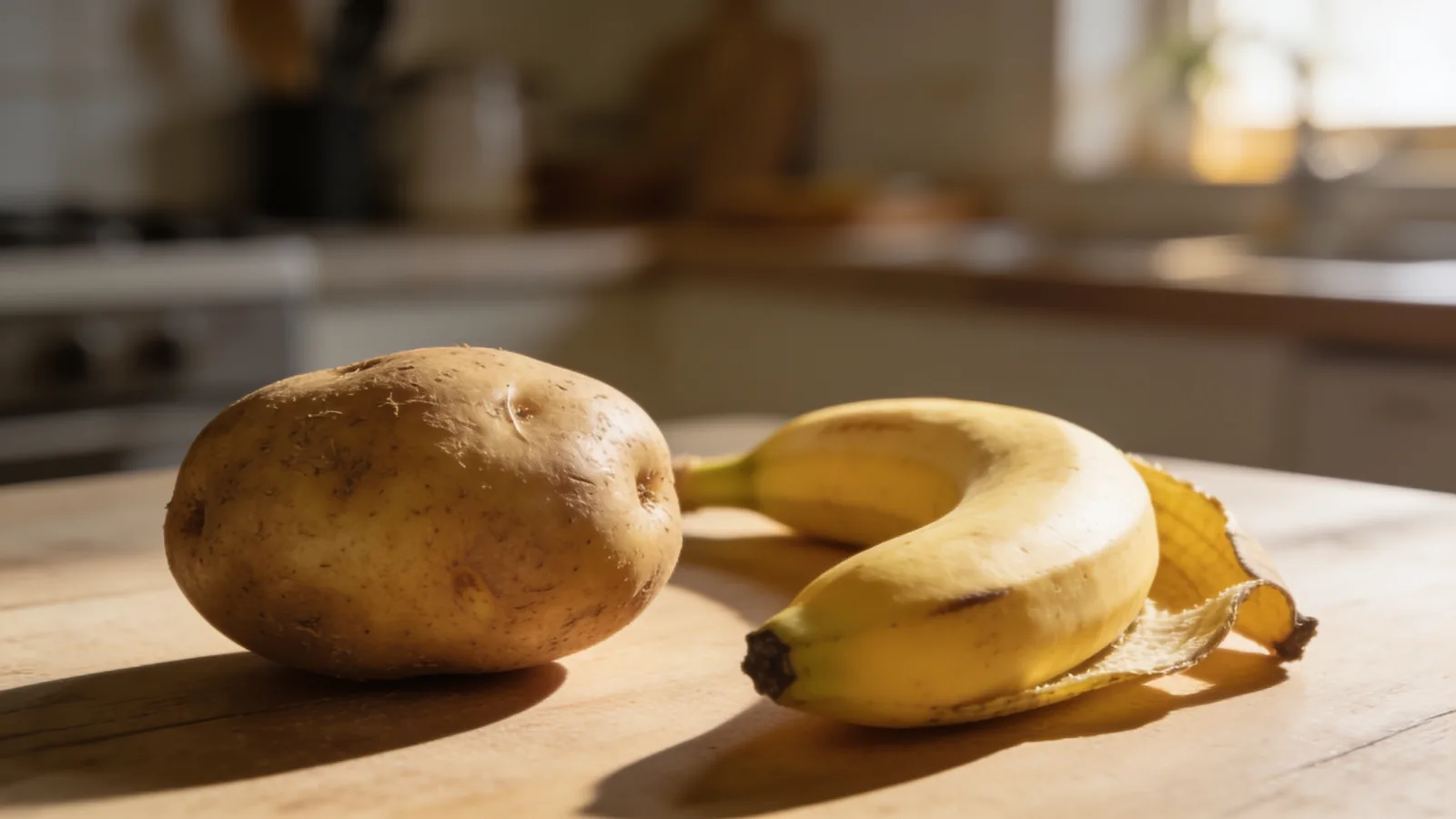
In the potato vs banana protein comparison, the potato wins by a clear margin: a medium potato contains roughly 4 to 5 grams of protein, while a medium banana holds about 1.3 grams. That is a three-to-fourfold difference, and it surprises people because both are usually filed under “carbs.” The more interesting story is not the gap in grams — it is the gap in protein quality, where the potato is further ahead than the raw numbers suggest.
Does a Potato Have More Protein Than a Banana?
Yes — a potato has more protein than a banana, by roughly three to four times. A medium potato provides about 4–5 grams of protein versus about 1.3 grams in a medium banana. Larger baking potatoes can reach 7–8 grams, while two bananas still total under 3 grams. Neither is a high-protein food, but the potato is the clear leader.
| Food | Typical serving | Protein |
|---|---|---|
| Medium potato (raw, ~150 g) | 1 potato | ~4–5 g |
| Large baking potato | 1 potato | ~7–8 g |
| Medium banana (~120 g) | 1 banana | ~1.3 g |
| Potato protein isolate | 100 g | 80–95 g |
Source note: Whole-potato and banana protein figures reflect standard food-composition data; isolate protein content (80–95% on a dry basis) is reported in the gluten-free baking literature on potato protein isolate.
The table makes the headline obvious and also makes a second point: the whole foods are both modest, and the only entry that reads like a real protein source is the isolate. That contrast is the whole point of this comparison.
Why a Potato Out-Proteins a Banana
The difference comes down to what each plant part is for. A potato is a tuber — an underground storage organ the plant uses to survive winter and regrow in spring. To do that, it stores not only starch but also a meaningful reserve of protein, dominated by patatin (the major storage protein) and a family of protease inhibitors. Those proteins are biologically functional, which is why a potato carries several grams of them.
A banana is a fruit. Its job is to attract animals, get eaten, and disperse seeds, so it invests its resources in sugar rather than protein. As a banana ripens, starch converts to simple sugars, and protein never becomes a priority. The result is a food that is pleasant, potassium-rich, and almost protein-free by comparison.
This is also why potato protein can be isolated commercially while banana protein cannot. Manufacturers extract potato protein from potato fruit juice — the liquid byproduct of starch production — concentrating it into an isolate. There is no equivalent banana stream because there is almost nothing to concentrate. If you want to understand how that extraction works and what the resulting ingredient actually is, start with what potato protein is.
Neither Is a “Protein Food” — The Honest Math
Here is the part most comparison articles skip: winning the potato vs banana protein contest does not make the potato a protein food. A 4–5 gram serving is real, but it is small against a daily target. Most adults aiming to preserve muscle want something in the range of 1.6 grams of protein per kilogram of body weight, which for many people means well north of 100 grams a day.
To get a single 25–30 gram protein dose from whole potatoes, you would need to eat five or more of them in one sitting — and absorb a large load of carbohydrate along the way. Bananas are worse: you would need around twenty to reach the same protein, which is not a plan, it is a dare. So the practical answer is that whole potatoes and bananas both contribute protein incidentally, not deliberately. For a fuller accounting of the tuber’s numbers, see how much protein a potato has and the honest take in are potatoes a good source of protein.
This is exactly the gap that an isolate fills. Concentrating potato protein to 80–95% by dry weight turns an incidental few grams into a usable 20–25 gram serving without the carbohydrate ballast.
Protein Quality: Grams Aren’t the Whole Story
Grams measure quantity. Quality is measured by scores like PDCAAS (Protein Digestibility-Corrected Amino Acid Score) and the newer DIAAS (Digestible Indispensable Amino Acid Score), which account for digestibility and the balance of essential amino acids. On these measures, the potato pulls even further ahead of the banana.
Potato protein isolate has a PDCAAS reported at 0.92–1.00, placing it on par with several animal proteins, and a DIAAS reported as high as 100% (Herreman et al., Food Science & Nutrition, 2020). It contains all nine essential amino acids. By contrast, plant proteins generally score lower than animal proteins, with wheat gluten landing around 0.25 because it is short on lysine (Schaafsma, Journal of Nutrition, 2000).
| Protein source | PDCAAS | Note |
|---|---|---|
| Egg / whey isolate | 1.00 | Reference-standard quality |
| Potato protein isolate | 0.92–1.00 | All nine essential amino acids |
| Wheat gluten | 0.25 | Limited by low lysine |
| Banana | — | No established score; protein negligible |
Source note: Egg and wheat-gluten PDCAAS values from Schaafsma, Journal of Nutrition, 2000 (PMID: 10867064); potato protein isolate range from published PDCAAS data on potato protein. A reliable PDCAAS for banana is not established because its protein content is too low to score meaningfully.
The banana has no established protein-quality score for the simple reason that there is not enough protein in it to score. That is the quiet conclusion of the whole comparison: the potato is not just quantitatively ahead, it is qualitatively in a different category. For a deeper look at how these scores work, see DIAAS vs PDCAAS and is potato protein high quality.
From Whole Potato to Potato Protein Isolate
The reason potato protein matters beyond trivia is that its quality survives concentration. When manufacturers isolate it, you get a high-quality protein in a serving size that actually moves the needle. A 2020 trial in young women found that 25 grams of potato protein isolate consumed twice daily stimulated muscle protein synthesis at rest and during recovery from resistance exercise (Oikawa et al., Nutrients, 2020). That is a direct demonstration that a plant protein extracted from a humble tuber can do the anabolic work people usually associate with whey.
It is worth being precise about what that study showed and did not show. In the exercised leg, protein ingestion did not add to muscle protein synthesis beyond exercise alone — but at rest, and as a tool for reaching a daily protein target, the isolate performed like a high-quality protein. The amino acid score of whole potato protein has been reported at 65%, and review work continues to describe potato protein as a high-quality, allergy-free source (Food Research International, 2021).
There is also an allergen angle that bananas and potatoes share, oddly enough. Potato is not among the FDA’s major allergens, which is part of why a single-ingredient potato protein appeals to people avoiding dairy, soy, egg, and nuts. If allergen avoidance is your priority, the allergen-free protein guide covers the details, and potato protein vs whey compares the two head to head.
How to Actually Get Potato Protein Into Your Day
If your goal is protein rather than potassium, the practical move is not to eat more potatoes or bananas — it is to use a concentrated source. A potato protein isolate provides 20–25 grams of protein per serving with no detectable flavor, so it disappears into oatmeal, soup, yogurt, or a smoothie that already contains a banana. In that smoothie, the banana does what it does best (sweetness and texture) and the isolate does what the banana cannot (deliver protein).
For people over 40, who lose muscle gradually and often under-eat protein for years, the math matters more than the trivia. Reaching 25–30 grams of high-quality protein per meal is far easier with an isolate than with whole tubers. See protein after 40 for targets, and the recipe index for ways to fold protein into ordinary meals without turning every dish into a shake.
Limitations and What the Numbers Don’t Tell You
A few caveats keep this comparison honest. First, the gram figures for whole potatoes and bananas vary with size, variety, and ripeness; the 4–5 gram and 1.3 gram numbers are representative, not fixed. Second, cooking method changes the eating experience but not the underlying protein much — a baked potato and a boiled one carry similar protein per gram of potato.
Third, much of the strongest muscle-synthesis evidence comes from potato protein isolate, not from whole potatoes, so it is fair to credit the ingredient rather than the side dish. The whole potato is a respectable contributor; the isolate is the genuine protein source. And finally, protein quality scores describe the protein itself, not the calorie cost of getting it — which is precisely why concentration, not consumption of more whole food, is the efficient path. On grams and on quality, though, the verdict holds: the potato beats the banana, and it is not close.