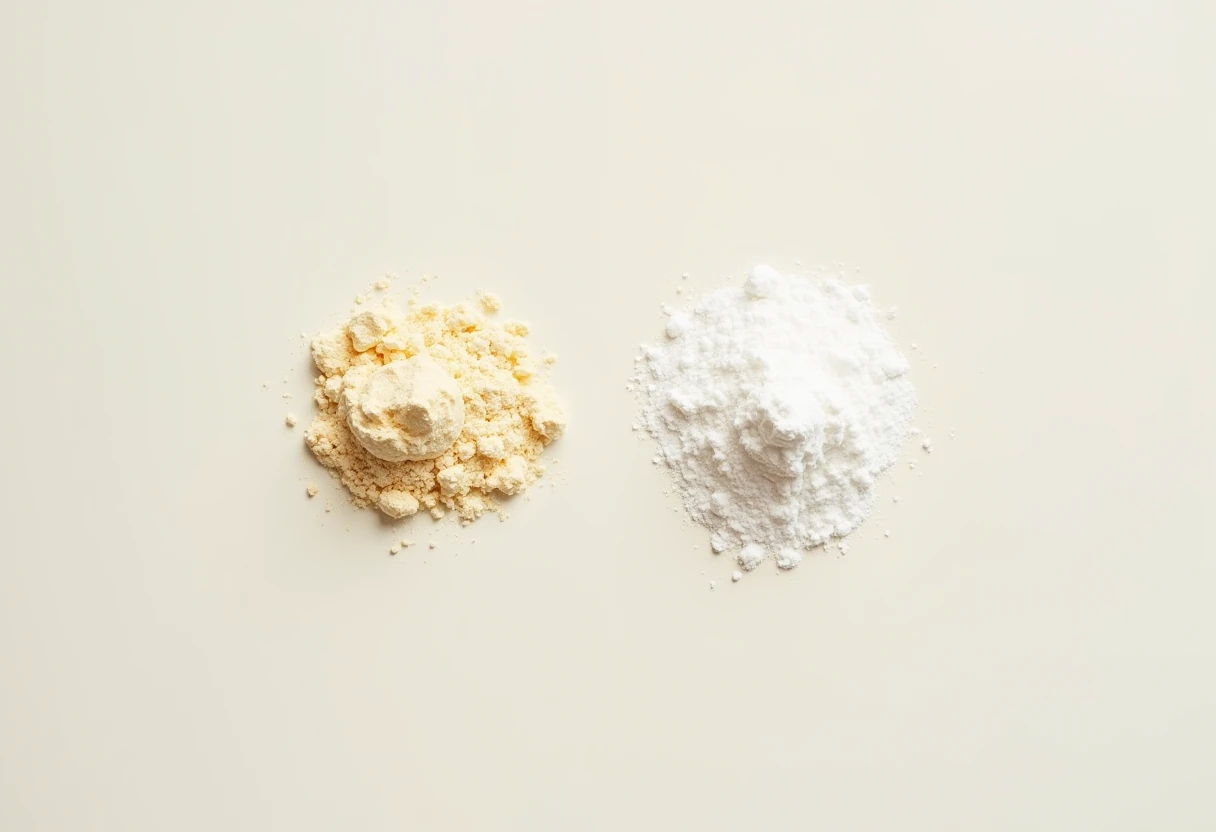
The core difference in potato protein vs collagen comes down to one absence: collagen contains no tryptophan, which makes it an incomplete protein under the PDCAAS method. Potato protein isolate contains all nine essential amino acids and stimulates muscle protein synthesis (MPS) at a 25g dose. If your goal is muscle, these two are not interchangeable.
Potato protein is a complete protein with a PDCAAS of 0.92–1.00, while collagen is incomplete — it lacks the essential amino acid tryptophan (0.00 g per 100 g) and is critically low in leucine. In a randomized trial, 30 g of collagen failed to raise myofibrillar protein synthesis above placebo, whereas whey did. For building or preserving muscle, potato protein is categorically more effective. Collagen has separate, legitimate uses for skin and joint connective tissue that do not involve muscle protein synthesis.
| Metric | Potato Protein Isolate | Collagen Peptides |
|---|---|---|
| Complete protein status | Complete — all nine essential amino acids | Incomplete — lacks tryptophan |
| PDCAAS | 0.92–1.00 | Effectively 0 (incomplete under PDCAAS) |
| Leucine per 25g | Adequate to trigger MPS | Critically low |
| Tryptophan presence | Present | 0.00 g per 100 g |
| Primary biological role | Muscle protein synthesis, dietary protein | Skin and joint connective tissue support |
These are not competing versions of the same thing. Potato protein is a dietary protein you eat to meet your protein target and to signal muscle growth. Collagen is a structural protein supplement marketed for skin elasticity and joint comfort. The marketing blurs this line constantly, which is why people buy collagen and quietly under-eat real protein for years.
-
You want to build or preserve muscle
-
You are counting toward a daily protein target
-
You need a complete protein with all nine essential amino acids
-
You avoid dairy, eggs, soy, or nuts and want one ingredient
-
Your specific interest is skin or joint connective tissue
-
You already meet your complete-protein needs elsewhere
-
You understand it will not contribute meaningfully to muscle
-
You are using it alongside — not instead of — a complete protein
Why Collagen Is Not a Complete Protein
Collagen is incomplete because it contains no tryptophan — an analyzed collagen sample measured 0.00 g of tryptophan per 100 g — and is low in several other indispensable amino acids. Under the PDCAAS method, a protein missing an essential amino acid scores at the bottom regardless of how well it digests.
That same research established a practical ceiling: because collagen lacks tryptophan, only about 36% of total daily dietary protein can be replaced with collagen peptides while still meeting indispensable amino acid requirements. Typical effective collagen doses studied for skin and joints (roughly 2.5 to 15 g per day) sit below that threshold — which is fine, as long as the rest of your protein comes from complete sources. Problems start when collagen becomes the protein.
Collagen vs Protein Powder for Muscle: What the Trials Show
For muscle protein synthesis, collagen does not perform like a complete protein. In a randomized controlled trial, 30 g of whey protein after resistance exercise significantly raised myofibrillar protein synthesis versus placebo (0.041 vs 0.032 %·h⁻¹), while 30 g of collagen (0.036 %·h⁻¹) did not reach significance; the rise in plasma leucine and essential amino acids was greater after whey than after collagen.
A separate trial in endurance-trained adults found the high-leucine, tryptophan-containing protein alpha-lactalbumin increased myofibrillar protein synthesis 13%±5% more than an equal-nitrogen collagen dose, and only alpha-lactalbumin meaningfully raised plasma leucine and tryptophan relative to collagen. The pattern is consistent: collagen does not deliver the leucine signal that drives MPS.
Potato protein sits on the other side of that line. In the McMaster study led by Stuart Phillips, consuming 25 g of potato protein isolate twice daily stimulated muscle protein synthesis at rest and during recovery from exercise in young women, while the placebo group showed no such increase. The authors concluded potato protein isolate is a high-quality plant protein capable of stimulating MPS. If you want the mechanics of how that isolate is produced and why it scores so well, see our explainer on what potato protein actually is.
The “Collagen for Muscle” Marketing Claim
Collagen for muscle gain is the claim with the weakest evidence. No, collagen does not stimulate muscle protein synthesis comparably to complete proteins — the controlled trials above show it failing to beat placebo for myofibrillar synthesis. The amino acid math explains why: collagen is dominated by glycine, proline, and hydroxyproline, and is low in the leucine that triggers the mTOR pathway responsible for building muscle.
This does not mean collagen is useless. Its glycine- and proline-rich profile is the entire point for connective tissue — skin, tendons, ligaments, cartilage. Those are real structures with real research interest. But “supports skin elasticity” and “builds muscle” are different claims, and only one of them holds up for collagen. When a label implies both, read it as marketing, not biology.
Protein Quality: PDCAAS and DIAAS Compared
Potato protein isolate carries a PDCAAS of 0.92–1.00, among the highest of any plant protein, and DIAAS values for potato protein have been reported as high as 100%. For comparison, egg protein scores 1.00 and wheat gluten scores around 0.25. Collagen, lacking tryptophan, scores at the floor of the PDCAAS scale despite digesting easily.
A useful nuance: two proteins with the same PDCAAS can still drive MPS differently, because absorption speed and leucine content matter beyond the score alone. That caveat works against collagen, not for it — its problem is not absorption but a missing amino acid and low leucine. For a deeper breakdown of these metrics, our guide on PDCAAS and protein quality walks through the math.
Allergens and Digestion
Potato protein isolate is a single-ingredient, non-animal protein extracted from potato fruit water, a byproduct of starch production. It is widely described as an allergy-free option because it avoids dairy, egg, soy, nuts, and gluten, and Monash University lists potato protein as a low-FODMAP source. Collagen is animal-derived, typically from bovine, porcine, or marine sources — relevant if you avoid those for dietary, ethical, or sensitivity reasons. If single-ingredient simplicity is your priority, our allergen-free protein guide covers what to look for.
One honest caveat: if you have a potato allergy, you should not consume potato protein — the allergen patatin is still present. For most people without that specific allergy, potato protein is among the lowest-reactivity protein options available.
References
- Paul C, et al. Significant Amounts of Functional Collagen Peptides Can Be Incorporated in the Diet While Maintaining Indispensable Amino Acid Balance. Nutrients (2019). PMID:31096622
- Aussieker T, et al. Collagen Protein Ingestion during Recovery from Exercise Does Not Increase Muscle Connective Protein Synthesis Rates. Medicine and Science in Sports and Exercise (2023). PMID:37202878
- Oikawa SY, et al. Lactalbumin, Not Collagen, Augments Muscle Protein Synthesis with Aerobic Exercise. Medicine and Science in Sports and Exercise (2020). PMID:31895298
- Oikawa SY, et al. Potato Protein Isolate Stimulates Muscle Protein Synthesis at Rest and with Resistance Exercise in Young Women. Nutrients (2020). PMID:32349353
- Herreman L, et al. Comprehensive Overview of the Quality of Plant- and Animal-Sourced Proteins Based on the Digestible Indispensable Amino Acid Score. Food Science & Nutrition (2020). PMID:33133540
- Schaafsma G. The Protein Digestibility-Corrected Amino Acid Score. The Journal of Nutrition (2000). PMID:10867064