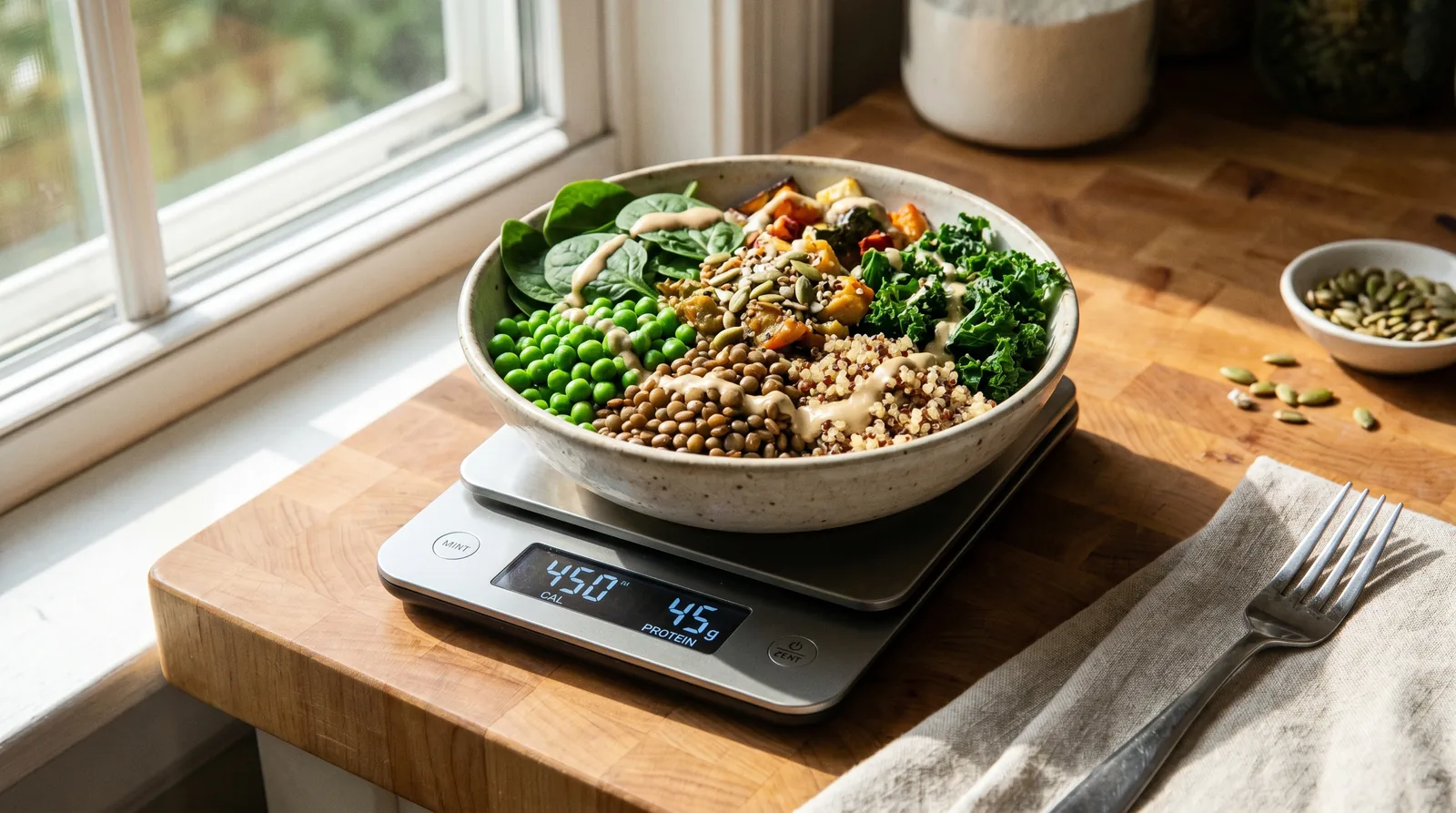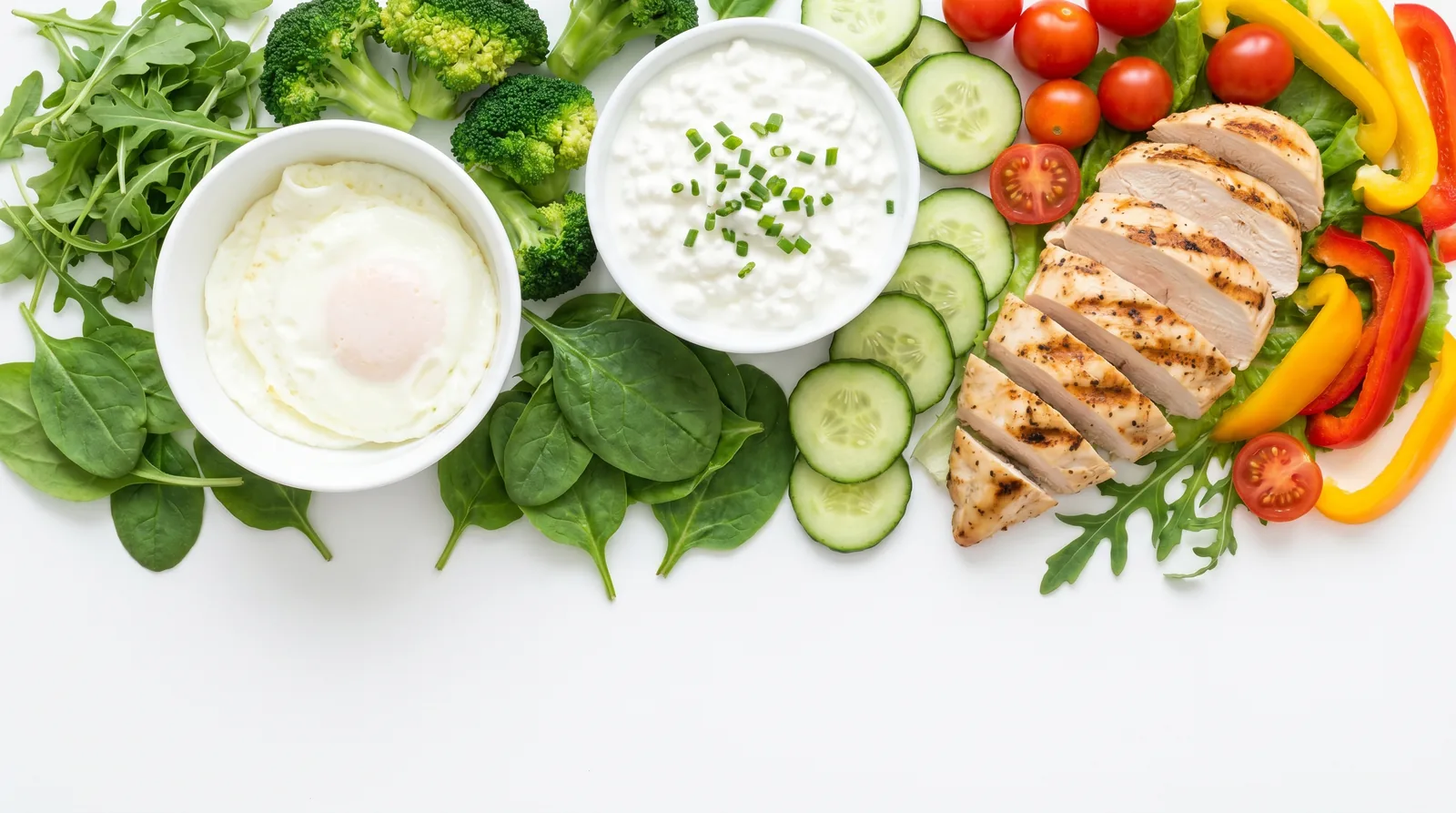
The lowest calorie protein source is whatever gets closest to being protein and nothing else. Protein supplies about 4 calories per gram, so a food that is 90% protein and almost no fat sits near the mathematical ceiling for protein density — roughly a quarter of a gram of protein per calorie. Protein isolates, egg whites, and lean poultry all cluster at that top end. Fat, at 9 calories per gram, is what drags most “high-protein” foods down the list.
The lowest calorie protein source is near-complete protein with minimal fat: protein isolates (90–95% protein), egg whites, and white poultry. Because protein provides about 4 calories per gram, a 90%+ protein isolate delivers close to 0.24 grams of protein per calorie — the practical maximum. Among whole foods, low-fat cottage cheese gives 14g of protein for 81 calories, and egg whites are almost entirely protein with no saturated fat.
This guide ranks protein sources by density — grams of protein per calorie — not by taste, price, or marketing. We evaluated each on the criteria below, then named picks across both powders and whole foods.
Top Options by Category
Potato Protein Isolate (single-ingredient)
Strongest all-around plant option
Potato protein isolate can run 80–95% protein on a dry basis, which puts its density alongside whey isolate while removing the four most common allergens. The amino acid profile is good enough to matter: 25g of potato protein isolate stimulated muscle protein synthesis at rest and after resistance exercise in young women (Nutrients, 2020, PMID:32349353), and the DIAAS for potato protein isolates has been reported as high as 100% (Food Science & Nutrition, Herreman et al., 2020, PMID:33133540). It is also a low-FODMAP protein source (Monash University, 2019), which most plant powders are not.
Pros:
- High protein percentage, near whey-isolate density
- No dairy, egg, soy, gluten, or nuts
- Low-FODMAP; easier on sensitive stomachs
- Single ingredient — never squint to read the label
Cons:
- Lower leucine than whey; absorbs more slowly
- Earthy taste needs a flavor partner
Whey Protein Isolate
Best density if you tolerate dairy
Whey protein isolate is 90–95% protein with less than 1% lactose (mindbodygreen, 2023), which gives it one of the highest protein-per-calorie ratios available and a PDCAAS that truncates at 1.00 — the maximum the scale allows (Journal of Nutrition, 2000, PMID:10867064). Its rapid digestion and high leucine make it the reference standard for stimulating muscle protein accretion (American Journal of Clinical Nutrition, 2011, PMID:21367943). If dairy is not a problem for you, this is the densest, best-studied option. We say so plainly.
Pros:
- 90–95% protein, PDCAAS 1.00
- Highest leucine of the common options
- Isolate carries less lactose than concentrate
Cons:
- Dairy-derived — off the table for milk allergy
- Concentrate (cheaper) is lower protein, higher lactose
Egg Whites (carton or separated)
Best whole-food density
Four egg whites (½ cup from a carton) contain 13g of protein and are almost entirely protein with no saturated fat (Cleveland Clinic, 2025). Egg protein scores a PDCAAS of 1.00, the maximum on the scale, so the quality matches the density. The yolk is where the fat and most of the calories live; removing it is the single fastest way to raise a food’s protein-per-calorie ratio.
Pros:
- Almost entirely protein, no saturated fat
- PDCAAS 1.00, complete amino acids
- Inexpensive, widely available
Cons:
- Egg allergen — unsafe for many kids
- Needs cooking; not a shake
Low-Fat Cottage Cheese (1% milkfat)
Best for satiety per calorie
Cottage cheese at 1% fat gives about 14g of protein for 81 calories per 113g serving (USDA FoodData Central). That is roughly 0.17 grams of protein per calorie — slightly below an isolate, but it is real food with casein, which digests slowly and keeps you full. It earns its place when the goal is feeling satisfied on a calorie budget rather than chasing the absolute densest number.
Pros:
- 14g protein for 81 calories
- Slow-digesting casein for staying support
- No preparation
Cons:
- Dairy — not allergen-free
- Sodium can be high; check the brand
Skinless Chicken Breast
Best dense protein at a meal
Chicken breast is cited by registered dietitians as one of the best high-protein, low-calorie foods. Skinless white meat is lean enough that nearly all its calories come from protein, and it anchors a meal in a way no shake does. It is the whole-food answer to “I want the densest protein on my plate.”
Pros:
- Lean, high protein-per-calorie when skinless
- Complete animal protein, no additives
- Versatile, filling
Cons:
- Requires cooking and portioning
- Density drops sharply with skin or breading
What to Look For on Your Own
Protein density is simple arithmetic: grams of protein divided by calories. Because protein is about 4 calories per gram and fat is about 9, the densest protein sources are the ones with the least fat. That is why a 90%+ isolate and egg whites beat steak, salmon, or whole eggs on density alone — the fattier foods carry more calories per gram of protein, even when they are excellent in other respects.
The table below compares the picks on the numbers we can verify. Where a reliable figure for a given cell does not exist, it is left as an em-dash rather than guessed.
| Source | Protein | Calories | Protein quality | Allergen-free? |
|---|---|---|---|---|
| Potato protein isolate | 80–95% by weight | — | DIAAS reported up to 100% | Yes |
| Whey protein isolate | 90–95% by weight | — | PDCAAS 1.00 | No (dairy) |
| Egg whites (4) | 13g | — | PDCAAS 1.00 | No (egg) |
| Cottage cheese, 1% (113g) | 14g | 81 | Complete (dairy) | No (dairy) |
| Chicken breast, skinless | — | — | Complete (animal) | Yes |
A few things the density number alone will not tell you:
Quality comes before density. Plant proteins generally carry lower protein quality scores than animal proteins, and the limiting amino acid varies — across new pea genotypes, methionine plus cysteine averaged only 2.6 g/100g of protein, a chemical score of about 46% (Molecules, 2024, PMID 39519674). Wheat gluten scores around 0.25 on PDCAAS against egg’s 1.00. A dense protein with a poor amino acid profile means your body uses less of what you eat. Potato protein isolate is one of the few plant options that is both dense and high quality. If the scoring systems themselves are new to you, our explainer on DIAAS vs PDCAAS is the place to start.
Isolate beats concentrate on density and on digestion. Whey isolate undergoes more processing than concentrate, so the final product is higher in protein and lower in carbohydrate; concentrate carries more of the FODMAP lactose (Monash University FODMAP). The same logic applies to plant powders — an isolate strips out more of the non-protein material, which raises both the density and, often, the tolerability.
Watch the additives, not just the macros. A “high-protein” label can hide a long ingredient list. It can also hide contaminants: in the Clean Label Project’s 2025 Protein Study 2.0, certified organic protein powders averaged three times the lead of non-organic products, and chocolate-flavored powders contained 110 times more cadmium than vanilla. The fewer the ingredients, the fewer the variables.
Density is a tool, not a goal. The reason to care about protein per calorie is that it lets you hit a protein target without overshooting calories — which is the whole problem when you are eating at a deficit. If that is your situation, read our pillar guide on protein for weight loss, and the practical breakdown of hitting 100g of protein under 1,200 calories. For grab-and-go ideas, our list of high-protein, low-calorie snacks applies the same math to real food. And if you want the longer story on the ingredient itself, see what potato protein is.