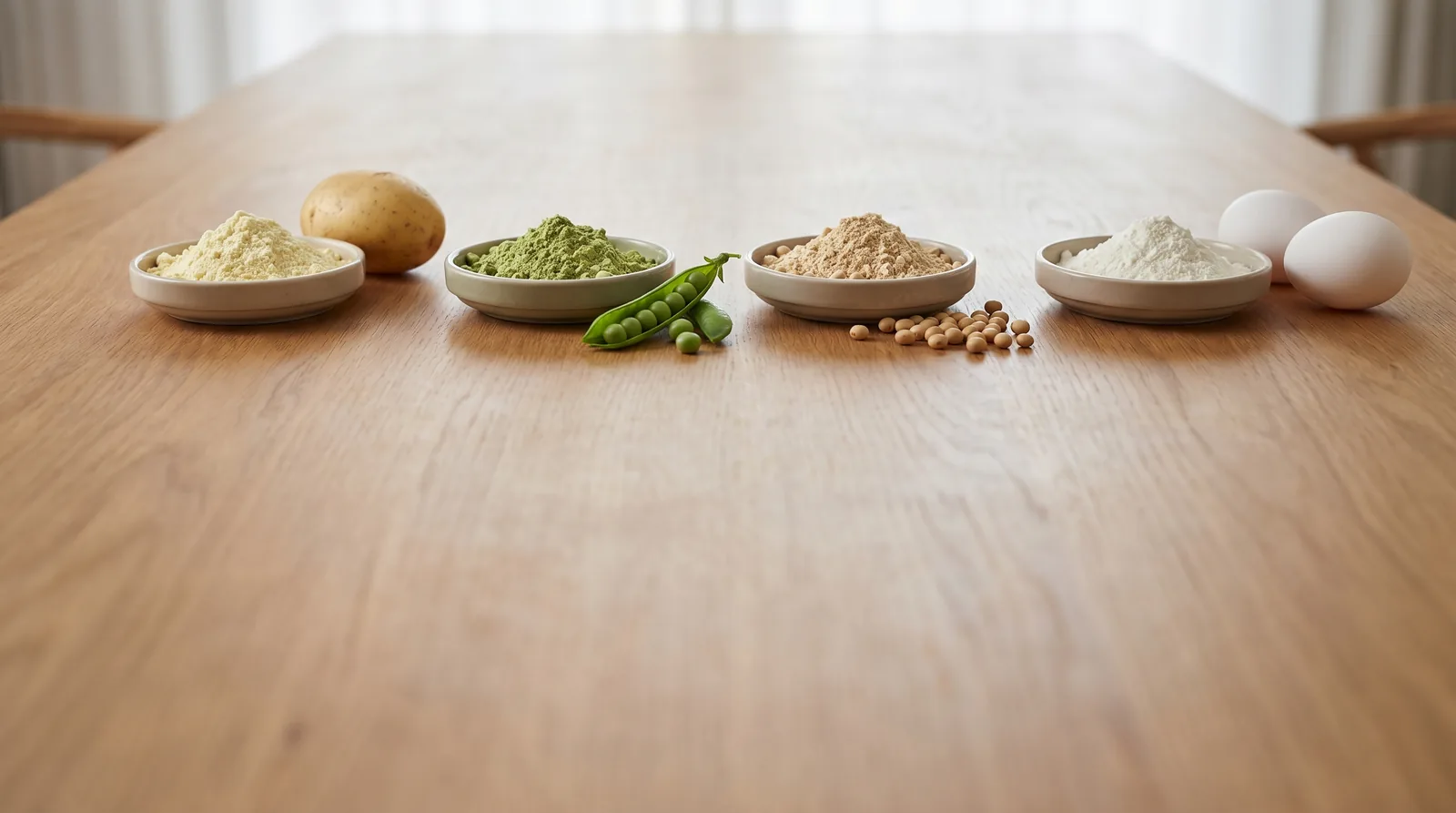
The healthiest protein powder is the one with the shortest ingredient list, a documented amino acid profile, and verified third-party testing for heavy metals — not whichever source markets itself the loudest. No single protein wins on every measure: whey isolate leads on muscle protein synthesis, plant sources lead on cardiovascular and environmental data, and potato protein isolate sits in a useful middle as a single-ingredient, low-FODMAP, allergen-free option. The honest answer is that “healthiest” is a set of trade-offs, and the contamination data published in 2025 matters more than most source debates.
There is no single “healthiest protein powder” — the best choice depends on your priorities. For complete amino acids and fastest muscle protein synthesis, whey isolate (90–95% protein, <1% lactose) leads. For the fewest ingredients, allergen safety, and low-FODMAP digestion, single-ingredient potato protein isolate is the standout. Across all sources, third-party heavy-metal testing matters most: a 2025 Clean Label Project analysis of 160 products found 47% exceeded at least one safety standard, with plant-based powders averaging five times more cadmium than whey.
We evaluated each powder below on ingredient transparency, protein-quality scores, third-party heavy-metal testing, digestibility, and allergen profile.
Top Options by Category
Single-Ingredient Potato Protein Isolate
Single-ingredient, allergen-free, low-FODMAP
Single-ingredient potato protein isolate is exactly that — one ingredient, nothing else. It typically contains 80–95% protein on a dry basis, and a 2020 trial found that 25g taken twice daily increased muscle protein synthesis at rest and after resistance exercise in young women (Nutrients, 2020, PMID:32349353). The researchers concluded potato protein isolate is a high-quality plant-based protein. DIAAS for potato protein isolates has been reported as high as 100% (Food Science & Nutrition, Herreman et al., 2020, PMID:33133540), and its PDCAAS is among the highest of any vegetable protein source. It is allergen-free — no dairy, soy, egg, gluten, or nuts — and Monash University classifies potato protein as low-FODMAP (Monash FODMAP, 2019), which makes it one of the few plant powders unlikely to ferment in a sensitive gut. Look for a manufacturer that publishes third-party heavy-metal testing.
Pros:
- One ingredient, nothing to read twice
- Documented muscle protein synthesis in a human trial
- Low-FODMAP and free of the top allergens
- Single-source, so easy to vet for third-party testing
Cons:
- Lower leucine and slower amino-acid release than whey
- Earthy taste some people notice in water
- Not the cheapest plant protein per gram
Unflavored Whey Isolate
Complete dairy protein, highest leucine
Whey isolate is a complete protein providing all nine essential amino acids, and isolates are typically 90–95% protein with less than 1% lactose. Its fast digestion and high leucine content make it more effective than casein or soy at stimulating muscle protein accretion in older men (American Journal of Clinical Nutrition, 2011, PMID:21367943). In a 2023 controlled trial, 30g of whey raised myofibrillar protein synthesis after resistance exercise where collagen did not (Med Sci Sports Exerc, 2023, PMID:37202878). If maximizing post-exercise synthesis is your single goal, whey is the reference standard. The trade-off is dairy: it is unsuitable for anyone on a dairy-free diet, and concentrate versions carry more lactose than isolate.
Pros:
- Complete amino acid profile, highest leucine
- Strongest evidence for muscle protein synthesis
- Isolate carries minimal lactose
Cons:
- Dairy allergen; not for dairy-free diets
- Lower heat stability for baking
- Larger environmental footprint than plant sources
Single-Ingredient Pea Protein
Single-ingredient, widely available, budget-friendly
Single-ingredient pea protein is just yellow pea protein — nothing else. It is widely available and inexpensive. Pea protein is lysine-rich — averaging 7.9 g per 100g protein across new genotypes, with leucine at 7.1 g per 100g — but its limiting amino acids are methionine plus cysteine, which average only 2.6 g per 100g (a chemical score of 46%) (Molecules, 2024, PMID 39519674). That gap is why pea is often blended with rice. The digestion caveat matters: Monash University notes that pea protein can be difficult to purify and often retains FODMAPs such as GOS and fructans, which can trigger IBS symptoms even in small amounts. For a sensitive gut, that makes pea a less predictable choice than potato.
Pros:
- Affordable and broadly stocked
- High lysine; complements grain proteins well
- Low environmental footprint
Cons:
- Limiting in methionine and cysteine
- Often retains FODMAPs (GOS, fructans)
- Plant powders averaged higher cadmium in 2025 testing
Organic Plant-Based Blend
Multi-ingredient plant blend, often flavored
An organic plant-based blend combines two or more plant sources — commonly pea, rice, and seed proteins — and typically supplies around 18–24g of protein per serving. Combining sources gives a more rounded amino acid profile than any single plant protein, since the limiting amino acid of one (such as pea’s methionine) is offset by another (such as rice). Two cautions apply: the 2025 Clean Label Project study found certified-organic protein powders averaged three times the lead of non-organic products, so “organic” is not a proxy for low heavy metals — ask for the testing data. And a longer ingredient list means more inputs for an autoimmune-aware reader to evaluate.
Pros:
- Rounded plant amino acid profile from multiple sources
- Often higher in total protein per serving than a single source
- Suits those avoiding dairy and egg
Cons:
- Multi-ingredient blend, not single-source
- Organic label does not guarantee low lead
- Added flavors, gums, and sweeteners in some versions
Picks at a Glance
| Pick | Source | Protein content | Complete protein | Allergen-free | Low-FODMAP |
|---|---|---|---|---|---|
| Potato protein isolate | Potato | 80–95% | Yes (high-quality) | Yes | Yes |
| Whey isolate | Dairy | 90–95% | Yes | No (dairy) | Higher in isolate form |
| Pea isolate | Legume | ~80% | Low in methionine | No (legume) | No (GOS, fructans) |
| Organic plant-based blend | Plant blend | ~18–24g/serving | Blended for completeness | Varies (no dairy/egg) | Varies |
What to Look For on Your Own
If you take one thing from this guide, make it third-party testing. The 2025 contamination data reframes the entire “healthiest” question. The Clean Label Project’s Protein Study 2.0 tested 160 products from 70 brands across 35,862 data points and found that 47% exceeded at least one federal or state safety standard (California Proposition 65), while 21% of samples exceeded twice the Prop 65 levels (Clean Label Project, 2025). Independent laboratory Ellipse Analytics ran the testing by ICP-MS and found plant-based powders contained five times more cadmium than whey-based products. Chocolate flavors were worse than vanilla — 110 times more cadmium, with 65% of chocolate powders exceeding Prop 65 limits. Consumer Reports’ separate October 2025 testing of 23 products reached a similar conclusion: more than two-thirds carried more lead per serving than its 0.5-microgram safe daily limit, and plant-based products averaged nine times the lead of dairy-based ones.
That does not mean plant protein is unsafe — it means the source matters less than whether a specific product is tested. A single-ingredient powder with a published Certificate of Analysis tells you more than any “organic” or “plant-based” badge. For a deeper walk-through of every factor, see our complete protein powder buyer’s guide, and if heavy metals are your main worry, our notes on third-party testing.
On protein quality, the hierarchy is real but narrower than marketing suggests. Animal proteins generally score higher on PDCAAS and DIAAS, and whey produces a faster, larger rise in essential amino acids and leucine than plant sources (J Nutr, 2024). In one head-to-head, a plant blend raised muscle protein synthesis to 0.041%/h versus whey’s 0.046%/h — meaningfully lower, but still a real anabolic response (J Nutr, 2024). For context on the scale, egg protein scores a PDCAAS of 1.00 while wheat gluten scores around 0.25 under the established FAO/WHO values. Potato protein isolate lands far closer to the egg end of that range than to wheat. If your goal is muscle, our breakdown of whey vs plant protein for muscle growth and what PDCAAS actually measures go further.
Finally, weigh the long-term health picture, not just the gram count. A 2024 analysis across three prospective cohorts found that people with the highest ratio of plant-to-animal protein had a 19% lower risk of cardiovascular disease (American Journal of Clinical Nutrition, 2024, PMID:39631999). For allergy and autoimmune households, the calculus is simpler: the fewest possible inputs win. Our allergen-free protein guide and primer on potato protein cover those cases in detail.