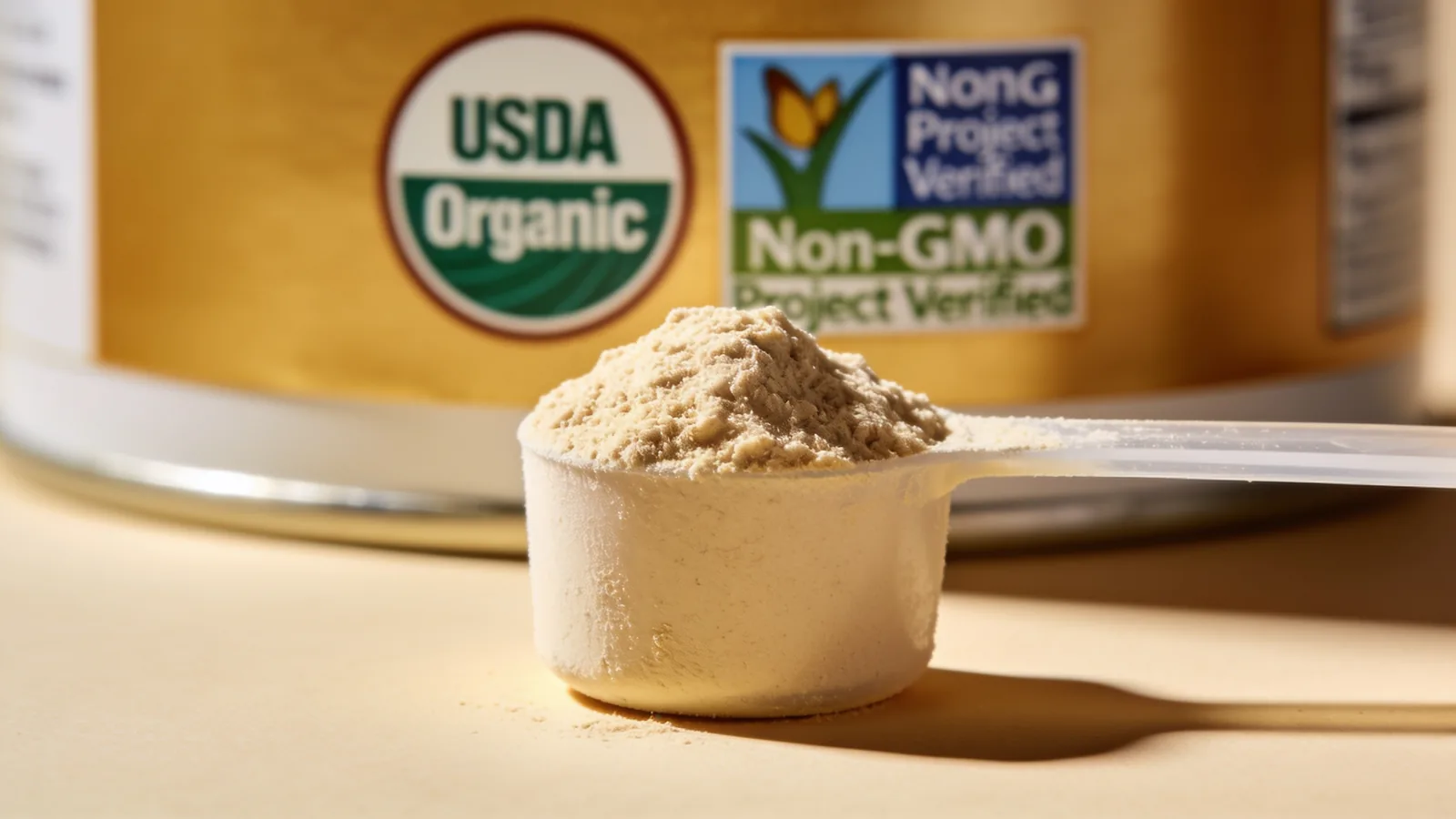
A non GMO organic protein powder carries two seals that describe how a crop was grown — and almost nothing about what ended up in the finished tub. USDA Organic certifies the absence of synthetic pesticides and fertilizers. Non-GMO Project Verified certifies the absence of genetically engineered ingredients. Neither one tests for lead, cadmium, protein quality, or how many ingredients are on the label.
Non-GMO Project Verified means a product contains no genetically engineered ingredients. USDA Organic means the crops were grown without synthetic pesticides or fertilizers. Neither label measures heavy metals or protein quality. In the Clean Label Project’s 2025 Protein Study 2.0, certified organic protein powders averaged three times the lead of non-organic products — so an organic seal is not a contamination guarantee.
We evaluated protein powders by what the labels can and cannot prove, then compared the categories on ingredient transparency, published contaminant testing, and protein quality.
Top Options by Category
Potato Protein Isolate
Single-ingredient, unflavored
One ingredient: potato protein isolate. It typically carries no USDA Organic seal. Potato protein is derived from non-GM potatoes, and its DIAAS has been reported as high as 100% (Herreman et al., Food Science & Nutrition, 2020, PMID:33133540). A 2020 trial found 25 g of potato protein isolate taken twice daily stimulated muscle protein synthesis in young women (Oikawa et al., Nutrients, 2020, PMID:32349353). It is a low-FODMAP protein source (Monash University, 2019), and it disappears into food.
Pros:
- Single ingredient — nothing to cross-react with
- DIAAS reported as high as 100%
- Low-FODMAP, dairy/soy/egg/nut-free
Cons:
- Rarely carries USDA Organic certification
- Usually unflavored — mixes plain, not dessert-like
Organic Plant-Based Blend
Certified organic, allergen-conscious
An organic plant-based blend suits buyers who specifically want both an organic seal and broad allergen avoidance. These certified-organic plant blends are usually multi-ingredient pea-and-rice formulas and typically deliver roughly 15–21 g of plant-based protein per serving. The honest caveat: organic certification does not address contamination, and certified organic powders averaged three times the lead of non-organic products in the Clean Label Project’s 2025 Protein Study 2.0.
Pros:
- USDA Organic and Non-GMO
- Broad allergen-conscious formulation
- Widely available
Cons:
- Multi-ingredient plant blend — more inputs to screen
- Organic seal does not certify low heavy metals
Organic Plant-Based Blend (Stevia-Free)
Certified organic, no stevia
For buyers who want a certified-organic, Non-GMO Project Verified powder without stevia, stevia-free organic plant blends exist, though protein per serving tends to be modest — often around 15 g — and the formula is a multi-ingredient blend. The category earns its place on the certification and sweetener avoidance, not on protein density.
Pros:
- USDA Organic, Non-GMO Project Verified
- No stevia, low or no added sugar
Cons:
- Protein per serving is often on the low side
- Multi-ingredient blend
Single-Ingredient Pea Protein
Single-ingredient, typically non-organic
A single-ingredient pea protein is just yellow pea protein — nothing else. It is often not USDA Organic, which is a useful reminder that the simplest label — a one-line ingredient list — is more informative than either seal. Pea protein’s limiting amino acids are methionine plus cysteine, which average a chemical score of 46% across new pea genotypes (Molecules, 2024, PMID 39519674), so amino-acid completeness is the trade-off.
Pros:
- Single ingredient
- Non-GMO pea source
Cons:
- Often not certified organic
- Limited in methionine and cysteine
What to Look For on Your Own
The central misunderstanding is that “organic” and “non-GMO” function as quality or safety grades. They do not. They are agricultural process labels. USDA Organic governs how the crop was farmed; Non-GMO Project Verified governs whether the crop’s genetics were engineered. A powder can carry both seals and still be high in contaminants, sweeteners, or filler — because none of those things are what the seals measure.
The data here is not subtle. In the Clean Label Project’s 2025 Protein Study 2.0 — which tested 160 products from 70 brands across 35,862 data points — 47% of products exceeded at least one federal or state safety standard (California Proposition 65), and 21% of samples exceeded twice the Prop 65 levels. Testing was performed by independent laboratory Ellipse Analytics using ICP-MS. Plant-based powders contained five times more cadmium than whey-based varieties, and certified organic powders averaged three times the lead of non-organic products. Chocolate-flavored powders contained 110 times more cadmium than vanilla varieties, with 65% of chocolate powders exceeding Prop 65 levels.
Consumer Reports reached a similar conclusion in October 2025: of 23 protein powders and shakes tested, more than two-thirds contained more lead per serving than the organization’s safe daily limit of 0.5 micrograms, and lead in plant-based products averaged nine times higher than dairy-based powders. Not every study finds alarm — a 2025 analysis of 22 powders by laser-induced breakdown spectroscopy and ICP-MS detected no heavy metals above regulatory limits (Journal of Nutritional Science, 2025, PMID:40703701), though the authors still recommended routine, mandatory heavy-metal testing. The honest takeaway across all three: the seal on the front is silent on this, so the document you actually want is a third-party Certificate of Analysis. For a deeper method, see our guide on how to verify which protein powders have no heavy metals.
Protein quality is the second thing neither seal certifies. On the PDCAAS scale — the FAO/WHO method that scores a protein against an essential-amino-acid reference pattern and truncates the result at 1.00 (Schaafsma, Journal of Nutrition, 2000, PMID:10867064) — egg protein lands at the top near 1.00 while wheat gluten falls to roughly 0.25. PDCAAS for potato protein is among the highest of any vegetable source. An organic pea-rice blend and a conventional egg-white powder can sit at opposite ends of that range with identical farming credentials. If protein quality is your priority, read the amino-acid profile, not the seal — our breakdown of what potato protein is walks through why isolate quality varies. For the full landscape across every protein type, our best protein powder guide compares them side by side.
Finally, the shortest label usually beats the most decorated one. A single-ingredient powder gives an allergy parent or autoimmune-aware adult fewer inputs to screen — no gums, no flavor maskers, no proprietary blend hiding soy lecithin. No certification replaces that. Our allergen-free protein guide covers why ingredient count matters more than any front-of-pack badge.
How the Categories Compare
| Category | Protein source | Organic / Non-GMO | Ingredients | Heavy-metal results published | Protein per serving |
|---|---|---|---|---|---|
| Potato protein isolate | Potato | Non-GMO potato / typically no organic seal | 1 | Varies by product | Varies by product |
| Organic plant-based blend | Pea / rice blend | USDA Organic + Non-GMO | Multiple | Varies by product | ~15–21 g |
| Organic plant-based blend (stevia-free) | Pea blend | USDA Organic + Non-GMO Project Verified | Multiple | Varies by product | ~15 g |
| Single-ingredient pea protein | Pea | Non-GMO / typically not organic | 1 | Varies by product | Varies by product |
Reliable per-serving protein figures and published contaminant panels are not available for every category above; ranges are approximate and vary by product.
References
- Clean Label Project, Protein Study 2.0 (2025).
- Consumer Reports, protein powder testing (October 2025).
- Journal of Nutritional Science (2025), PMID:40703701.
- Herreman et al., Food Science & Nutrition (2020), PMID:33133540.
- Oikawa et al., Potato Protein Isolate Stimulates Muscle Protein Synthesis at Rest and Exercise Recovery in Young Women, Nutrients (2020), PMID:32349353.
- Schaafsma G., The Protein Digestibility-Corrected Amino Acid Score, Journal of Nutrition (2000), PMID:10867064.
- Foods (2024), pea amino-acid composition, PMC11547519.
- Monash University FODMAP (2019).