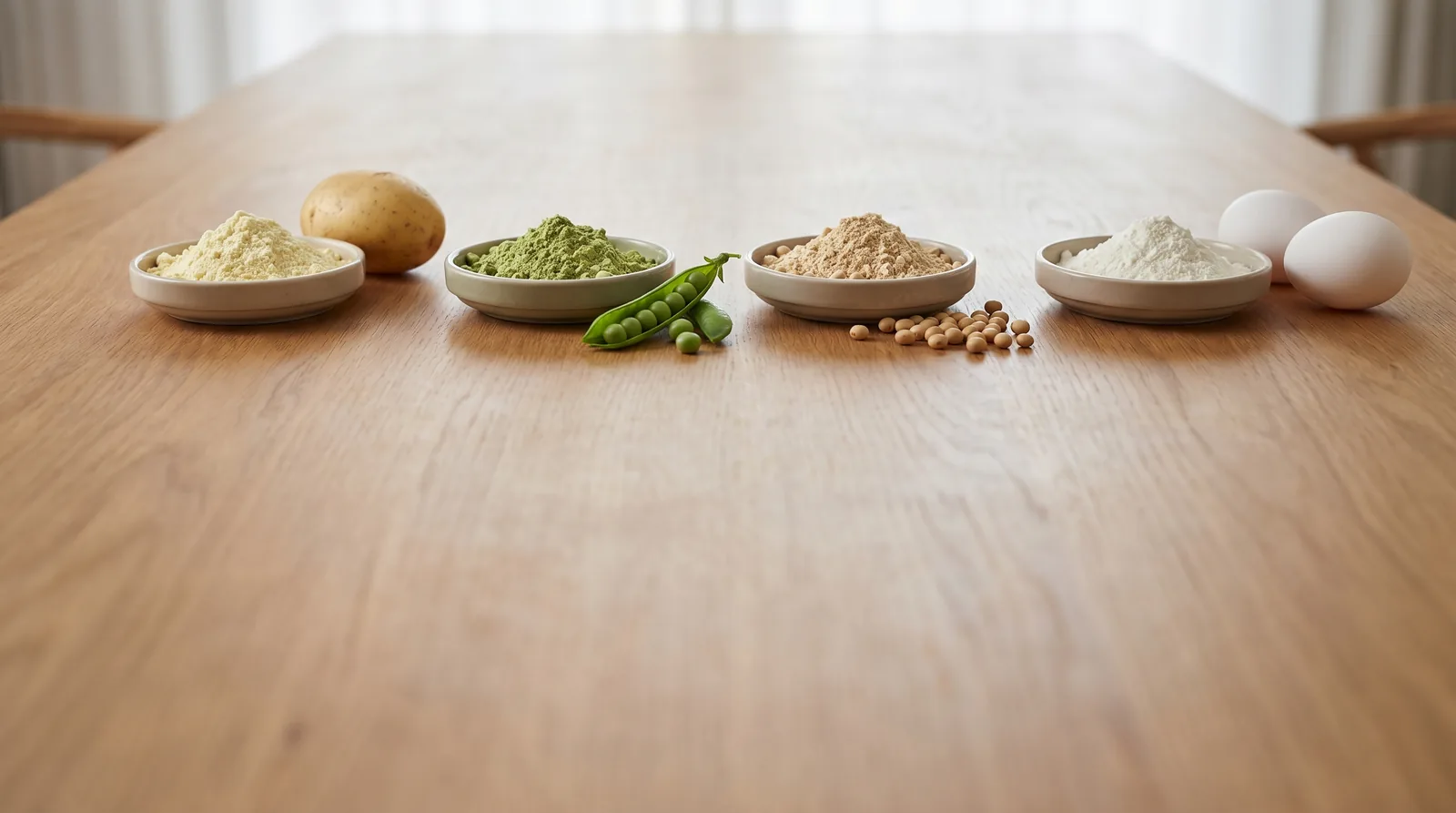
A hypoallergenic protein powder is one built to avoid the ingredients most likely to trigger an immune reaction. By that standard, single-ingredient potato protein isolate is unusual: potato is not among the FDA’s nine major food allergens, it contains no dairy, egg, soy, nut, or gluten, and it still scores a PDCAAS of 0.92–1.00 — on par with several animal proteins. That combination is rare.
No protein powder is universally hypoallergenic, because almost any food protein can provoke a reaction in someone. But single-ingredient potato protein isolate avoids all nine FDA major allergens — milk, egg, fish, shellfish, tree nuts, peanuts, wheat, soybeans, and sesame — and is recognized as a low-FODMAP source by Monash University. The one real exception: people with a diagnosed potato allergy, who should avoid it because the allergenic potato proteins remain present.
If you have spent any time reading labels, you already know the problem. The proteins marketed to allergy-sensitive buyers are frequently blends — pea plus rice plus a “natural flavor” line you cannot decode. The appeal of potato protein is that the ingredient list is the entire argument. Below is where it actually sits on the allergen map, and the caveat nobody selling it likes to print.
How Allergenic Protein Powders Compare
The table below maps common protein sources against three things that matter to an allergy-aware or autoimmune-aware reader: whether the base ingredient is a regulated major allergen, whether it tends to carry FODMAPs, and its protein-quality score. Reliable PDCAAS values are not established for every plant source, so those cells are left without a number.
| Protein source | FDA major allergen? | FODMAP load | PDCAAS |
|---|---|---|---|
| Potato protein isolate | No | Low (Monash) | 0.92–1.00 |
| Whey (dairy) | Yes — milk | Higher in concentrate (lactose) | 1.00 |
| Soy isolate | Yes — soybean | Can contain GOS/fructans | 1.00 |
| Pea | No | Can contain GOS/fructans | ≥0.75 |
| Rice | No | Variable | — |
| Egg white | Yes — egg | Low | 1.00 |
| Wheat/gluten | Yes — wheat | High (fructans) | 0.25 |
Two things stand out. First, the proteins with the cleanest allergen status on paper — pea, rice, potato — are not equal on quality or digestion. Pea and soy can carry FODMAPs that trigger IBS symptoms, and Monash University notes plant proteins are often difficult to purify of those compounds. Potato protein is the rare plant source that is both outside the major-allergen list and low-FODMAP. Second, potato’s PDCAAS sits beside whey, soy, and egg, not below them. Egg white scores around 1.00 on the FAO/WHO PDCAAS scale and wheat gluten roughly 0.25; potato lands at the top of that range.
What Makes a Protein Powder Hypoallergenic?
A protein powder is considered hypoallergenic when its base ingredient is not a regulated major allergen and the formula adds nothing else that commonly provokes reactions. The strongest version of that is a single-ingredient powder with no flavors, gums, or sweeteners. The fewer the inputs, the fewer the things to react to.
The FDA requires that any protein derived from a major food allergen be declared on the label — the Big 8 plus sesame, added in 2023. Potato is not on that list, and it is not among the 14 allergens regulated in the EU either. Potato protein is also Generally Recognized As Safe (GRAS) by the FDA for regular consumption. For the allergy parent whose child cannot have dairy, eggs, nuts, or soy, single-ingredient means the label answers the question in one line. You never have to squint to read it. For a deeper breakdown of how to evaluate any “allergen-friendly” claim, see our Allergen-Free Protein Guide.
The Honest Caveat: Potato Allergy Is Real
Potato is not a major allergen, but a potato allergy does exist, and anyone with one should not consume potato protein. The Center for Research on Ingredient Safety (CRIS) at Michigan State University states plainly that “if you have a potato allergy, you should not consume potato protein as the allergen is still present.” Isolation removes starch and water; it does not remove the proteins that cause the reaction.
The primary potato allergens are patatin (Sol t 1) and several protease inhibitors (Sol t 2, Sol t 3, Sol t 4). A murine model identified patatin and a 53 kDa protein as the main allergenic components (Molecular Immunology, PMID:30031281). Potato allergy is uncommon and tends to travel with other atopic conditions: among people with potato allergy, ImmunoCAP records report 4.7% had asthma, 11% allergic rhinoconjunctivitis, and 14.4% atopic dermatitis. There is one quirk worth knowing — potato allergens are heat-labile, destabilizing around 50°C through aggregation rather than denaturation (Pots et al. 1998; Koppelman et al. 2002), which is why some people react to raw but not cooked potato. That nuance does not change the rule: a diagnosed potato allergy is a hard stop.
Potato protein isolate should not be described as “allergen-free” in absolute terms, because that phrase is doing more marketing than reporting. The accurate claim is narrower and more useful: potato protein avoids the nine allergens responsible for the overwhelming majority of food-allergy reactions, while remaining unsuitable for the small group specifically allergic to potato.
Cross-Reactivity: Latex and Nightshades
Cross-reactivity happens when the immune system recognizes a protein in one source as structurally similar to one it already reacts to, so IgE antibodies bind both. For potato, two questions come up: latex and other nightshades.
On latex: cross-reactivity between latex proteins and potato patatin has been observed by immunoblot inhibition (Clinical & Experimental Allergy, PMID:8732238). But it is not blanket. A separate study found no cross-reactivity between specific isoforms of the latex allergen Hev b 7 and potato patatin (PMID:10589016), showing the effect is allergen-specific, not universal. On nightshades — tomato, pepper, eggplant — cross-reactivity within the Solanaceae family is possible but not universal, owing to homologous patatin-like and protease-inhibitor proteins (Case Reports in Pediatrics, PMID:40955319). The practical takeaway: if you have a known latex or nightshade allergy, treat potato protein as something to clear with your allergist first, not assume safe and not assume dangerous.
FODMAPs, Digestion, and Single-Ingredient Formulas
Potato protein is recognized as a low-FODMAP source by Monash University, which matters because Monash also notes that protein powders run 70–90% protein yet are frequently high in FODMAPs — even small amounts can trigger IBS symptoms. Soy and pea proteins can be difficult to purify of GOS and fructans; whey concentrate carries more lactose than whey isolate. A low-FODMAP, single-ingredient powder removes several of those variables at once. If digestion is your main concern, our guide on FODMAP-friendly protein powder goes deeper.
Single-ingredient formulas also sidestep a problem most allergen conversations ignore: contamination. The Clean Label Project’s 2025 Protein Study 2.0 tested 160 products from 70 brands across 35,862 data points and found 47% exceeded at least one federal or state safety standard (California Proposition 65), with 21% of samples exceeding twice the Prop 65 levels. Fewer inputs mean fewer entry points for that kind of variability.
Is Potato Protein Actually Worth Eating?
Avoiding allergens is only half the question; the protein still has to do its job. It does. A 2020 trial found that 25 g of potato protein isolate taken twice daily increased muscle protein synthesis rates in young women, while a placebo group showed no change (Nutrients, PMID:32349353). The DIAAS for potato protein isolates has been reported as high as 100% (Food Science & Nutrition, Herreman et al., PMID:33133540). Among plant sources, potato, canola, pea, and quinoa all reach a PDCAAS of at least 0.75 (Nutrients, PMID:33266120) — potato sits at the top of that group. It disappears into food, which is the point: you get a high-quality protein without dairy, soy, egg, or gluten riding along. For the science of how it is made and what it is, start with What Is Potato Protein?