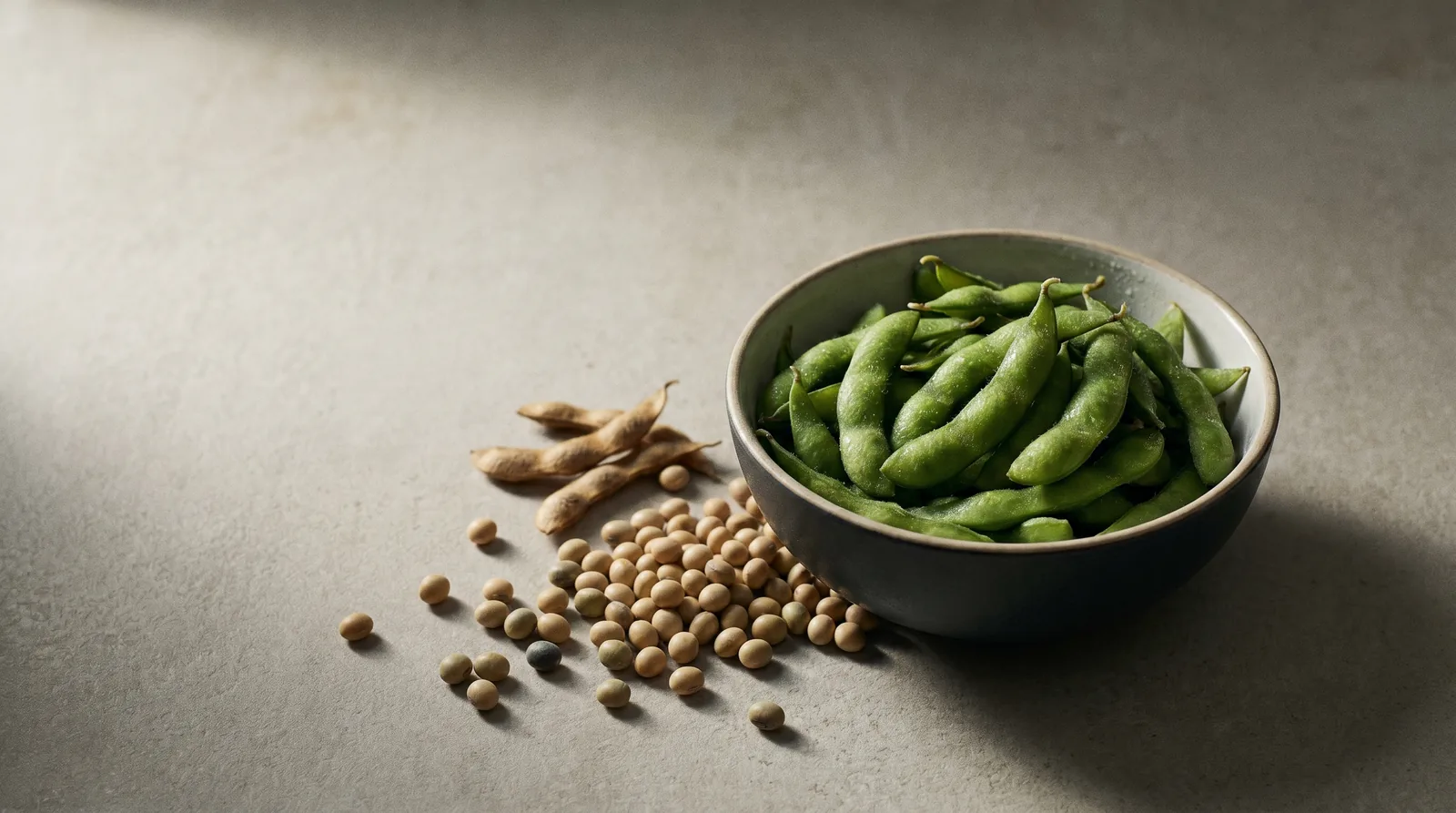
Finding a protein powder without soy is harder than it should be, because soy is one of the cheapest complete plant proteins on the market and one of the easiest to bury in an ingredient list. Soy protein isolate scores a 1.00 on PDCAAS — the maximum, since the FAO/WHO method truncates values to 100% (J Nutr, PMID:10867064) — so manufacturers reach for it to round out the amino acid profile of a “plant blend.” Soy lecithin, a separate ingredient, then shows up as an emulsifier in powders that otherwise have nothing to do with soy beans.
A genuinely soy-free protein powder almost always means a single-ingredient isolate: potato, pea, rice, or whey listed alone, with no soy protein and no soy lecithin. Soy hides in two places on a label — as soy protein isolate inside multi-source “plant blends,” and as soy lecithin, an emulsifier added for mixability. The U.S. FALCPA law requires soy to be declared, so the word “soy” must appear somewhere; the safest signal is an ingredient list short enough to read in one breath.
Soy-Free Protein Sources Compared
Soy is one of the FDA’s nine major allergens, which means it must be named on any label that contains it. The trouble is rarely deception — it is that “plant protein” sounds soy-free when it often is not. The table below compares the common protein bases on soy status, allergen footprint, and protein quality.
| Protein source | Typically soy-free? | Protein quality | Allergen notes |
|---|---|---|---|
| Potato protein isolate | Yes (single-ingredient) | DIAAS reported as high as 100% (Food Sci & Nutr, PMID:33133540) | Described as an allergy-free source; low-FODMAP (Monash, 2019) |
| Pea protein isolate | Yes (single-ingredient) | Limiting amino acid is methionine + cysteine (chemical score 46%) | Legume; generally well tolerated but a legume nonetheless |
| Rice protein isolate | Yes (single-ingredient) | Reliable PDCAAS figures are not well established | Grain-based; low allergenicity |
| Soy protein isolate | No — it is soy | PDCAAS 1.00 (truncated maximum) | Major allergen; common in cheap “plant blends” |
| Multi-source “plant blend” | Often no — check every line | Varies | Frequently includes soy protein and/or soy lecithin |
| Whey isolate | Yes for soy; no for dairy | PDCAAS 1.00 (truncated maximum) | Soy-free but contains milk; soy lecithin sometimes added |
Why So Many Plant Powders Still Contain Soy
Manufacturers add soy for two unrelated reasons: nutrition and texture. Soy protein isolate is a complete protein at a low cost per gram, so it props up blends built mostly from cheaper, incomplete proteins like rice. Soy lecithin is a different problem — it is an emulsifier added in tiny amounts to help powder disperse in liquid instead of clumping. Both put “soy” on the label, even when the marketing on the front says “pea and rice.”
This matters most for the allergy household. For a child who cannot have dairy, eggs, nuts, or soy, a single stray emulsifier line undoes the whole point. That is the core argument for single-ingredient powders, and it is the reason our allergen-free protein guide treats ingredient count as the first filter, before taste or price. The fewer inputs, the fewer things to react to.
Where Soy Hides on the Label
Soy appears under more than one name. Reading the front of the tub is not enough — the answer is always in the small print on the back. Look for these terms:
- Soy protein isolate — a primary protein source, common in low-cost blends.
- Soy lecithin — an emulsifier; small amount, still a declared allergen.
- Soy protein concentrate — a less-refined protein source.
- “Plant protein blend” with an unspecified list — read every component.
- “Natural flavors” — broad and opaque; not necessarily soy, but worth a query to the manufacturer.
Some products have built their entire positioning around avoiding this. A plant-based ready-to-drink (RTD) shake, for example, may certify itself free from the top eight allergens, including soy. Single-ingredient powders take a different route: one protein, listed once, nothing to emulsify. Some single-source plant powders are marketed as a one-ingredient product as well. The common thread among the genuinely soy-free options is a short list, not a marketing claim.
Is Soy Actually Bad? An Honest Look
No — for most adults, soy is a perfectly good protein, and the reason to avoid it is allergy or sensitivity, not danger. Soy protein isolate hits the maximum PDCAAS of 1.00, and soy consumption has shown favorable effects on serum lipids, lowering LDL and triglycerides. If you tolerate soy, there is no nutritional reason to fear it.
There are two honest caveats. First, soy stimulates muscle protein synthesis less strongly than whey after resistance exercise, attributed to whey’s faster digestion and higher leucine content (Journal of Applied Physiology, PMID:19589961). Second, and more practically: the people searching for protein powder without soy are usually doing it because their immune system or their child’s leaves no choice. For them, “soy is fine for most people” is beside the point. A single-ingredient isolate sidesteps the question entirely.
Soy-Free Does Not Automatically Mean Low Heavy Metals
One trap worth naming: dropping soy does not guarantee a contaminant-free powder. Recent testing found plant-based protein powders carried meaningfully higher heavy-metal loads than dairy-based ones. Consumer Reports tested 23 powders and shakes in 2025 and reported lead levels in plant-based products averaging nine times higher than dairy-based powders (Consumer Reports, 2025). The Clean Label Project’s 2025 Protein Study 2.0 found plant-based powders contained five times more cadmium than whey-based varieties, with testing performed by Ellipse Analytics using ICP-MS (Clean Label Project, 2025).
The takeaway is not “avoid plant protein.” It is that allergen status and contaminant status are separate questions, and you should verify both. A soy-free powder that comes with a current Certificate of Analysis answers both at once.
How to Verify a Powder Is Genuinely Soy-Free
Reading the label is the first step; confirming it is the second. A practical checklist:
- Read the full ingredient list, not the front panel. Soy must be declared by law.
- Check the allergen statement (“Contains:” line) and any “may contain” cross-contact warning.
- Prefer single-ingredient powders — one protein, no emulsifier, nothing to hide soy inside.
- For a child with multiple allergies, choose a product made on a soy-free line or one with third-party allergen testing.
- Ask the manufacturer directly what “natural flavors” covers if the term appears.
Among single-ingredient plant options, potato protein isolate stands out for the allergy-conscious. A 2021 review in Food Research International describes potato protein as an allergy-free source with an Amino Acid Score of 65% (PMID:34507729), and Monash University classifies potato protein as a low-FODMAP source (2019) — relevant for anyone whose soy avoidance overlaps with IBS. For a deeper comparison of how it stacks up against other low-allergen bases, see how potato protein compares on allergenicity, and for muscle outcomes, a 2020 trial found 25g of potato protein isolate twice daily stimulated muscle protein synthesis at rest and after exercise in young women (Nutrients, PMID:32349353).
When the label reads “potato protein isolate” and stops, there is no soy line to miss, no emulsifier to question, and nothing to cross-reference against an allergy list.