How much protein on a GLP-1 (Ozempic/Wegovy/Zepbound) and how to keep muscle comes down to two levers you control: a daily protein target you hit even when you are not hungry, and resistance training to give that protein somewhere to go. On these medications appetite drops sharply, total food intake falls, and protein is usually the first macronutrient to slip — which is exactly the macronutrient your muscle depends on while you are in a calorie deficit.
On a GLP-1 medication, aim for at least 1.0–1.2 g of protein per kg of body weight per day — the range the ESPEN Expert Group recommends to maintain muscle mass in older adults — and treat that as a floor, not a ceiling, while losing weight (Clinical Nutrition, 2014, PMID:24814383). Split it across 3–4 meals of roughly 25–40 g each, and pair it with resistance training. Without the training stimulus, protein alone does not build or hold muscle.
This matters because rapid weight loss is rarely all fat. A meaningful share of the loss can be lean tissue, and the appetite suppression that makes GLP-1 drugs effective also makes under-eating protein almost the default. A 2025 market survey found 74% of GLP-1 users were already seeking high-protein or protein-fortified products (Food Business News, 2025) — the instinct is right; the execution is where people fall short. Here is the practical sequence.
How to Hit Your Protein Target on a GLP-1
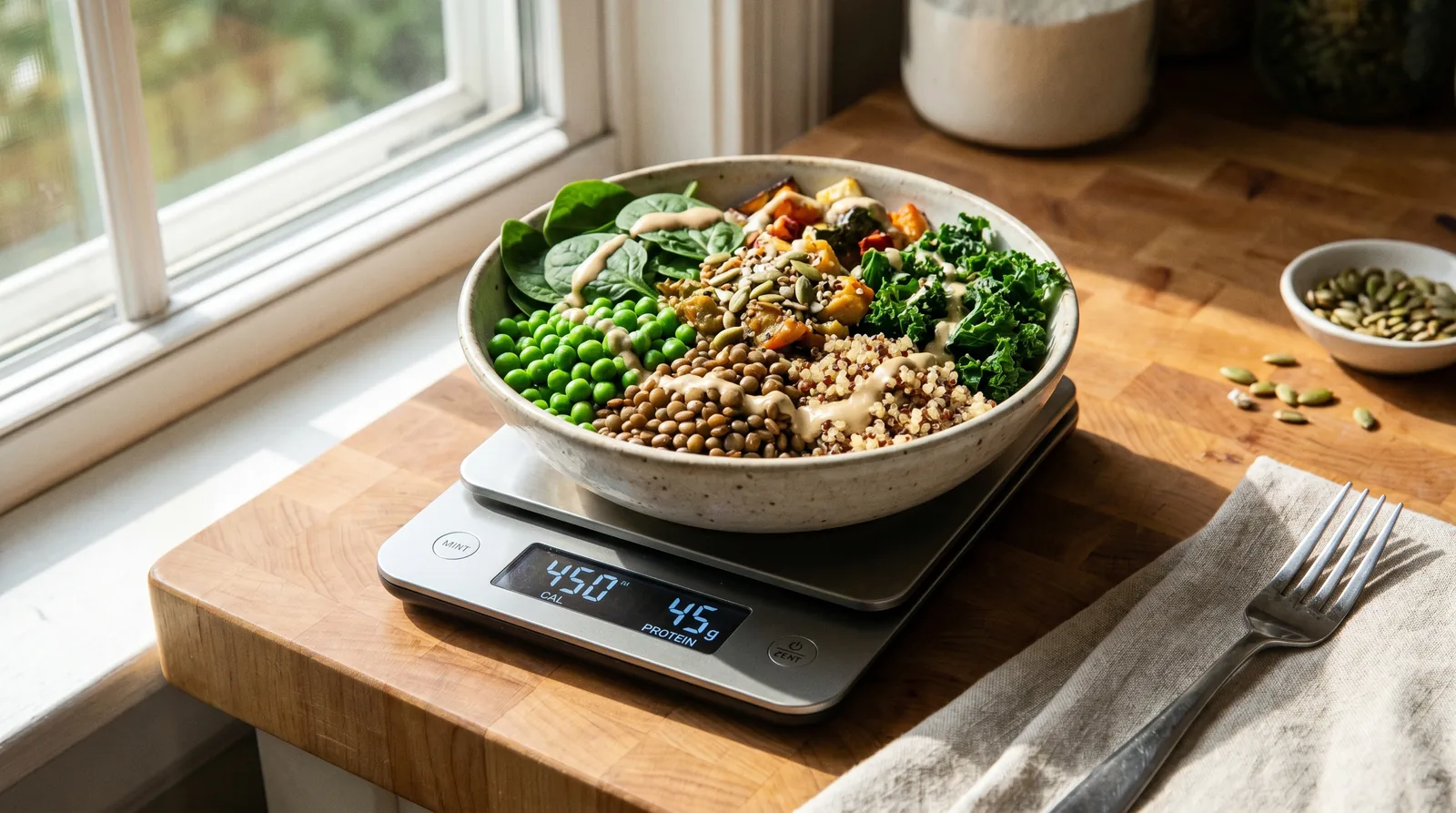
Hold onto muscle while you lose fat by hitting a daily protein floor, spreading it across meals, and lifting twice a week. What you need: A kitchen scale · A protein source that goes down easily · A way to track grams · Two resistance sessions a week · Time: 15 min to set up
Set your daily protein floor
Take your body weight in kilograms and multiply by 1.0–1.2 g to find your baseline. A 75 kg person lands at roughly 75–90 g per day. The ESPEN Expert Group recommends this range to maintain muscle mass and function in older adults (Clinical Nutrition, 2014, PMID:24814383), and a calorie deficit is precisely when you want the upper end of it. Protein also increases satiety and thermogenesis more than carbohydrate or fat (Journal of the American College of Nutrition, 2004, PMID:15466943), so a higher floor works with the medication rather than against it.
Tip: If you are actively losing weight, treat 1.2 g/kg as the minimum and edge higher. The cost of slightly too much protein is small; the cost of too little, while in a deficit, is lean tissue you have to rebuild later.
Clear the leucine threshold at each meal
Leucine is the primary amino acid that triggers muscle protein synthesis. Hitting roughly 2.5–3 g of leucine per meal is what flips the switch from breakdown to building. This is where protein quality earns its keep: plant proteins generally deliver less leucine per gram than whey. A controlled trial showed a 20 g plant-protein blend supplied only 1.5 g leucine — half a comparable whey dose — and produced a smaller synthesis response. When free leucine was added to bring the blend to 3.0 g, its synthesis rate (0.049%/h) became statistically indistinguishable from whey (0.046%/h; P = 0.052) (J Nutr, 2024, PMC11153912). The lesson: meet the leucine number and the source matters far less.
Distribute protein across 3–4 meals
Do not pile your day’s protein into one dinner. The case for per-meal protein targets is strong with age — distribution across meals may matter as much as total daily intake for holding muscle (The Journal of Frailty & Aging, 2016, PMID:26980369). Aim for 25–40 g at each of three or four eating occasions. On a GLP-1 this is also a practical move: when one large meal feels impossible, three smaller protein-forward ones are far easier to finish.
Pitfall: A common mistake is letting breakfast slide to coffee and skipping lunch because nothing sounds good — then trying to “make it up” at dinner. The body cannot bank a missed morning dose. Each meal is its own anabolic opportunity.
Add resistance training — this is non-negotiable
Protein powder alone does not build muscle; it has to be paired with resistance exercise. That is not a slogan — it is the mechanism. Muscle grows only when synthesis outpaces breakdown over time (Sports Medicine, 2014, PMID:24791918), and resistance training plus protein are the two primary levers that drive synthesis. Two full-body sessions a week is enough to give the protein you are eating a job to do. Without the training stimulus, extra protein in a deficit is just spared, not built. For the full picture on protecting lean mass while losing fat, see our guide on how to lose fat without losing muscle.
Pick a protein that goes down when appetite does not
When the medication suppresses hunger, the protein you will actually finish is the one that disappears into something you can tolerate. A single-ingredient isolate stirred into yogurt, soup, oatmeal, or mashed potato adds 20–25 g without bulk or a thick shake you cannot face. Potato protein isolate is one option here: it is a high-quality plant protein — 25 g twice daily measurably stimulated muscle protein synthesis in women (Nutrients, 2020, PMID:32349353) — and Monash University classifies it as a low-FODMAP source, which matters when GLP-1 drugs already slow digestion and a sensitive gut is common. You can read more about it in our guide to potato protein.
Tip: It disappears into your food. Stir a scoop into the soup or mash you were already going to eat rather than forcing down a second “meal” your appetite is fighting.
Track for two weeks, then adjust
Most people on a GLP-1 dramatically overestimate how much protein they are getting once total food intake drops. Log everything for two weeks against the floor you set in Step 1. If you are consistently short — which is the usual finding — close the gap with the easiest lever first: a scoop in something you already eat, or an extra protein-forward snack. Nitrogen balance is the underlying logic here; a negative balance signals a catabolic state and a positive one an anabolic state, and total intake is what tips it.
Checklist
- Daily floor set at 1.0–1.2 g protein per kg, higher during active weight loss
- 25–40 g protein at each of 3–4 meals, not stacked into one
- ~2.5–3 g leucine cleared at each meal
- Two resistance sessions a week, every week
- A protein source you can finish despite reduced appetite
- Two weeks of tracking, then adjust upward if short