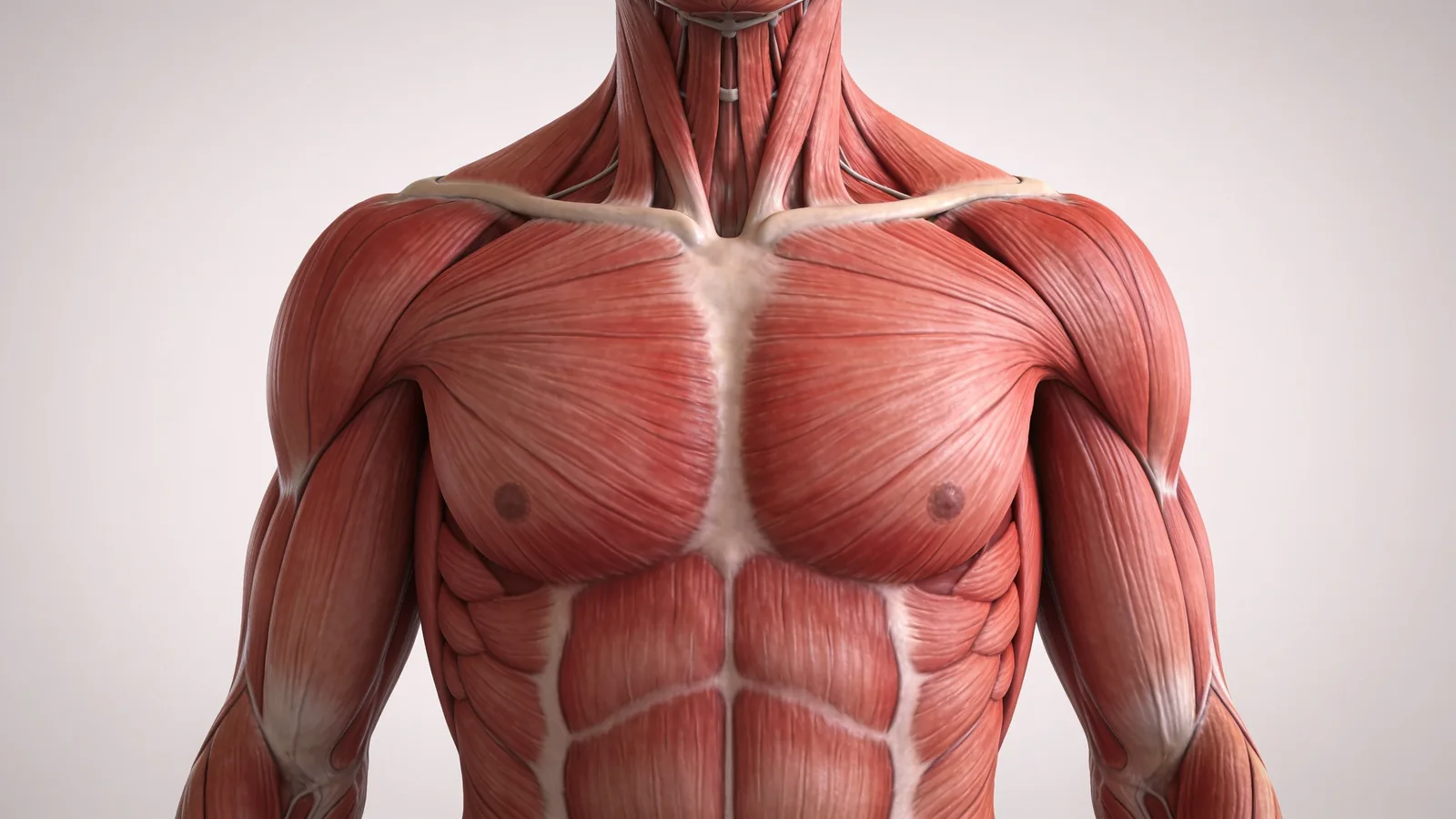
Muscle wasting in elderly adults — clinically termed sarcopenia — is asymmetrical: muscle is lost faster than it is regained. The European consensus defines sarcopenia by the progressive loss of muscle mass and function that accompanies aging (Age and Ageing, 2010; PMID:20392703). The core reason rebuilding is slow is anabolic resistance: aging muscle responds less strongly to the protein you eat (Anabolic resistance of muscle protein synthesis with aging, 2013; PMID:23558692).
Muscle atrophies quickly during inactivity and undereating, but rebuilding it is slower and requires two inputs together: resistance exercise and adequate protein. Aging blunts the muscle’s response to protein — anabolic resistance — so older adults need more than the standard RDA. The ESPEN Expert Group recommends 1.0–1.2 g of protein per kg of body weight per day for older adults (Clinical Nutrition, 2014; PMID:24814383), paired with resistance training.
What Is Muscle Wasting in the Elderly?
Muscle wasting in the elderly is the progressive loss of skeletal muscle mass and strength that accompanies aging, defined clinically as sarcopenia (Age and Ageing, 2010; PMID:20392703). It results from the balance tipping toward muscle protein breakdown over synthesis, driven by lower physical activity, inadequate protein intake, and reduced muscle sensitivity to feeding.
Muscle is in constant turnover. Growth or maintenance happens only when muscle protein synthesis (MPS) exceeds muscle protein breakdown (MPB) over time (Sports Medicine, 2014; PMID:24791918). Dietary amino acids stimulate MPS, and insulin suppresses MPB — so both eating enough protein and staying active matter. Inadequate protein intake, in particular, contributes to the reduction of skeletal muscle and bone mass in older adults (Nutrition in Clinical Practice, 2015; PMID:25107954).
How Fast Do Muscles Atrophy?
Muscles atrophy fastest during disuse and undereating, when MPS drops below MPB. Disuse directly reduces mTORC1 signaling and muscle protein synthesis (Nutrients, 2016; PMID:27376322). Even in young, healthy people, a drop in physical activity can produce anabolic resistance that cannot be overcome by eating more protein alone — a warning that movement is non-negotiable.
The rate is not uniform. It depends on age, baseline muscle mass, illness, bed rest, and protein intake. In older adults the loss compounds because the same period of inactivity does more damage on a muscle that is already less responsive to feeding. This is why a single hospital stay or a few weeks of immobility can leave an older person measurably weaker. To understand when the decline begins, see our overview of the sarcopenia timeline.
Why Aging Speeds Up Muscle Loss: Anabolic Resistance
Aging speeds muscle loss through anabolic resistance — a blunted rise in muscle protein synthesis after protein intake (PMID:23558692). A hallmark of aging is reduced sensitivity of skeletal muscle to the anabolic effects of both protein feeding and resistance exercise, so older adults extract less muscle-building signal from the same meal or workout as a younger person.
The response is also delayed, not just diminished. The peak synthetic response to combined resistance exercise and essential amino acid ingestion occurs later in older adults than in the young (PMID:18323467) — there is a temporal component to anabolic resistance, not only a magnitude one. Anabolic resistance does not look identical in everyone: some individuals are resistant to elevated amino acids, others to exercise, and some to both, which is why interventions need to be individualized (PMID:34026802). The practical upshot, reviewed in the clinical-care literature, is that older adults need a larger per-meal dose of protein to clear the same anabolic threshold (PMID:29389741). Our deeper explainer on anabolic resistance in older adults walks through the mechanisms.
How Quickly Can You Rebuild Muscle?
Rebuilding muscle is slower than losing it and requires resistance exercise and adequate protein together. Protein on its own does not build muscle — it must be combined with resistance training. In older adults with sarcopenia, dietary protein supplementation can positively influence muscle mass and strength (PMID:36505918), and good nutrition can help limit and treat age-related declines (Clinical Nutrition, 2014; PMID:24814383).
Plant protein is capable of stimulating that rebuilding signal. In a 2020 trial, 25 g of potato protein isolate consumed twice daily stimulated muscle protein synthesis at rest and after resistance exercise in young women (Nutrients, 2020; PMID:32349353). That study was conducted in young women, not older adults — so it demonstrates that potato protein isolate is a high-quality anabolic protein, but it does not, on its own, prove an MPS response specifically in elderly women. Because of anabolic resistance, older adults likely require a larger per-meal dose than the young women in that trial to reach the same effect.
How much regain is realistic depends heavily on starting point, training, and consistency. The evidence on what is achievable later in life is summarized in our reviews of whether sarcopenia can be reversed and rebuilding muscle after 70.
How Much Protein Do Older Adults Need to Rebuild?
Older adults need more protein than the standard 0.8 g/kg/day RDA. Evidence indicates that protein intake above the RDA improves muscle mass, strength, and function in the elderly (Optimal protein intake in the elderly, 2008; PMID:18819733), and the ESPEN Expert Group recommends 1.0–1.2 g/kg of body weight per day for older adults (Clinical Nutrition, 2014; PMID:24814383).
Distribution matters as much as the daily total. A case has been made for per-meal protein recommendations in aging, with the spread of protein across meals being as important as the 24-hour intake for maintaining muscle (J Frailty Aging, 2016; PMID:26980369). In practice that means anchoring each main meal with a meaningful protein dose rather than loading it all at dinner. For a full framework on intake across the decades, see the cluster guide on protein after 40.
Some reports also suggest middle-aged and older women may lose muscle mass and strength at a steeper rate than men of the same age, though the underlying mechanisms are not firmly established. The practical takeaway is unchanged: reaching the per-meal protein threshold and training against resistance matters regardless of sex.
Protein Quality and Muscle Wasting
Not all protein clears the anabolic threshold equally. Leucine is the amino acid most associated with triggering muscle protein synthesis, and proteins higher in leucine and faster to digest tend to produce a stronger acute response — which is why whey stimulated postprandial muscle protein accretion more effectively than casein in older men, an effect the authors attributed in part to whey’s higher leucine content (American Journal of Clinical Nutrition, 2011; PMID:21367943).
The table below compares common protein sources on digestibility-corrected quality and their relevance for older adults trying to preserve or rebuild muscle.
| Protein source | DIAAS (digestibility-corrected quality) | Relevance for older adults |
|---|---|---|
| Potato protein isolate | Reported as high as 100% | Stimulated MPS at rest and after exercise in young women (Nutrients, 2020) |
| Casein | ~115% | Slow digestion; whey outperformed it for acute MPS in older men |
| Pea protein isolate | ~82% | Produced muscle gains comparable to whey in resistance-training trials |
| Whey | — | Fast digestion, high leucine; superior acute MPS in older men |
| Collagen | Incomplete (lacks tryptophan) | Not a complete protein; does not raise myofibrillar MPS the way whey does |
DIAAS figures for potato (up to 100%), pea (~82%), and casein (~115%) come from controlled digestibility analyses; a reliable whey DIAAS value is not given here and is left as an em-dash rather than estimated. Collagen is categorized as incomplete because it lacks the indispensable amino acid tryptophan (Nutrients, 2019; PMID:31096622), and 30 g of collagen failed to raise myofibrillar protein synthesis above placebo while 30 g of whey did (Med Sci Sports Exerc, 2023; PMID:37202878). For older adults the lesson is to choose a complete protein with enough leucine, then make sure the per-meal dose is large enough to overcome anabolic resistance. Potato protein isolate is one such complete, single-ingredient option — more on what potato protein is.