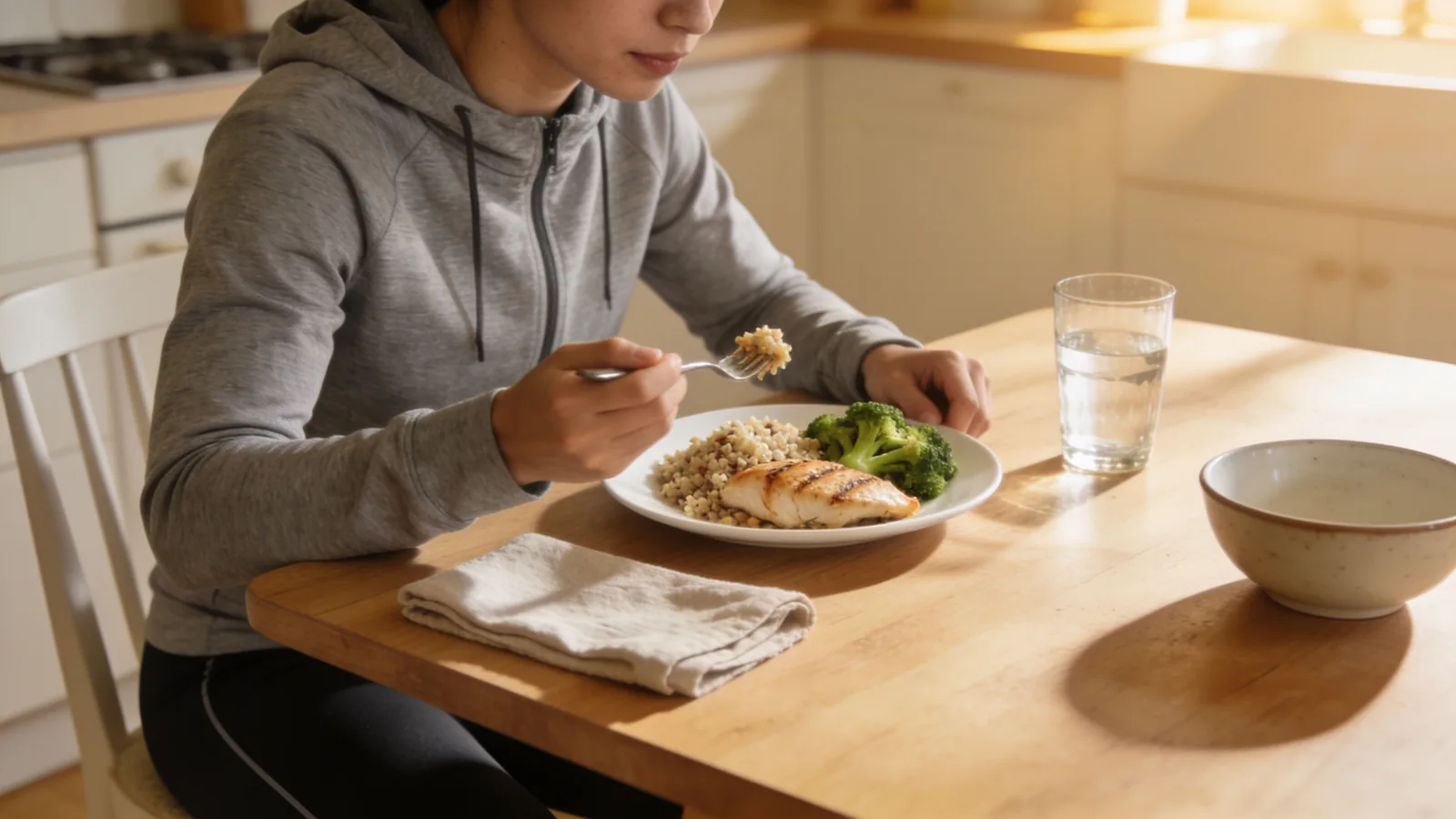
Does protein timing really matter? For most people, the answer is no — not the way the supplement industry framed it. A 2013 review concluded the post-exercise anabolic window for maximally stimulating muscle protein synthesis is several hours wide, not the 30 to 60 minutes you were told to panic about, and that total daily protein and energy intake matters more than precise timing (Journal of the International Society of Sports Nutrition, 2013, PMID:23360586).
The anabolic window is real but far wider than the classic “30-minute” claim. The 2013 review in the Journal of the International Society of Sports Nutrition (PMID:23360586) found the post-exercise window for muscle protein synthesis spans several hours, and that total daily protein intake outweighs exact timing. Timing matters most in two cases: training fasted, and older adults with anabolic resistance. Hitting roughly 1.6–2.2 g/kg of protein per day, spread across meals, is what drives muscle growth.
The 30-minute window made for excellent marketing. It implied that a shake gulped on the gym floor was the difference between progress and waste. The actual evidence is calmer, and slightly more demanding: it asks you to eat enough protein, from a decent source, across the whole day — every day. Below is what the research supports, and the narrow set of situations where the clock does count.
What the Muscle Protein Synthesis Numbers Actually Show
The most useful way to read the timing debate is to look at how much different protein doses raise myofibrillar muscle protein synthesis (MPS), measured as a percentage per hour. The table below collects values from controlled trials. The pattern is clear: the source and leucine content of the protein move the needle far more than whether you swallowed it at minute 5 or minute 90.
| Condition | Myofibrillar MPS (%/hour) | Source |
|---|---|---|
| Postabsorptive baseline (fasted, no protein) | 0.015 | J Nutr, 2024 (PMC11153912) |
| 30g collagen after resistance exercise | 0.036 | Med Sci Sports Exerc, 2023 (PMID:37202878) |
| 20g plant-protein blend | 0.041 | J Nutr, 2024 (PMC11153912) |
| 30g whey after resistance exercise | 0.041 | Med Sci Sports Exerc, 2023 (PMID:37202878) |
| 20g whey protein | 0.046 | J Nutr, 2024 (PMC11153912) |
| 20g plant blend fortified to 3.0g leucine | 0.049 | J Nutr, 2024 (PMC11153912) |
Two things stand out. First, any adequate protein dose roughly doubles or triples MPS over the fasted baseline — the rise is large and forgiving. Second, when researchers added free leucine to a plant blend to reach 3.0g, its MPS response (0.049%/h) became statistically indistinguishable from whey (J Nutr, 2024, PMC11153912). Leucine content, not stopwatch precision, is the lever.
Is the Anabolic Window Real?
The anabolic window is real, but it lasts several hours, not 30 minutes. After resistance exercise, muscle stays more receptive to protein for an extended period — one sports dietitian describes a roughly two-hour span when muscle is especially receptive to nutrients for repair (Memorial Hermann). The original narrow-window claim overstated how quickly that receptivity closes.
Muscle growth happens when muscle protein synthesis exceeds muscle protein breakdown over time (Sports Medicine, 2014, PMID:24791918). That “over time” is the key phrase. A single post-workout shake is one data point in a 24-hour ledger. If you trained at 6pm and ate a protein-containing dinner at 7:30pm, you are comfortably inside the window. The mTOR signaling that follows resistance exercise begins within an hour and persists, so the protein you eat over the next few hours all contributes.
This is why athletes obsess over the wrong variable. If you want a grounded overview of intake targets for training, our protein for athletes guide covers the daily numbers that actually predict results.
What Matters More Than Timing
Total daily protein, protein quality, and per-meal distribution all outrank timing. The 2013 review was explicit that total intake of protein and energy is more important than precise timing (PMID:23360586). Get these three right and the window takes care of itself.
Total daily intake
Most research points to roughly 1.6–2.2 g of protein per kilogram of body weight per day for people training to build muscle. Endurance athletes need about 1.5 to 2 times the protein of a sedentary person (Trail Runner Magazine, Kylee Van Horn, RDN, 2021). No amount of perfect timing compensates for falling short of the daily total.
Per-meal distribution
How you spread protein across the day may matter as much as the total, particularly for maintaining muscle as you age (Journal of Frailty & Aging, 2016, PMID:26980369). Three or four meals each containing 25–40g of quality protein keeps MPS elevated across the day far better than loading it all into one meal. This is a distribution question, not a stopwatch question.
Protein quality and leucine
The source matters because leucine is the primary trigger for MPS. A 20g plant-protein dose supplied only 1.5g of leucine — half the leucine of an equivalent whey dose — and produced a lower MPS response until it was fortified to 3.0g (J Nutr, 2024, PMC11153912). If you want the mechanics, see our breakdown of how much leucine per day to build muscle.
When Protein Timing Does Matter
Timing becomes meaningful in two specific situations: training in a fasted state, and being an older adult with anabolic resistance. Outside those cases, the multi-hour window absorbs ordinary variation in when you eat.
If you train fasted
For people who train in a fasted state — say, a pre-breakfast lifting session — post-workout protein timing is more critical, and prompt intake is likely beneficial. When you start exercise with no amino acids circulating from a recent meal, muscle protein breakdown runs higher, so getting protein in soon after training closes that gap. If you ate a protein-containing meal within a few hours before training, this concern largely evaporates.
If you are over about 50
Aging blunts the muscle’s response to protein, a condition called anabolic resistance (PMID:23558692). The peak synthetic response to combined resistance exercise and amino acids is also delayed in older adults compared with the young (Journal of Applied Physiology, 2008, PMID:18323467). Practically, that means older adults benefit from higher per-meal protein doses and may see better results from not stretching the gap between training and eating. Expert recommendations suggest older adults need 1.0–1.5 g/kg/day to counter anabolic resistance. Our guide to protein after 40 goes deeper on this.
Does the Protein Source Change the Timing Answer?
Yes, slightly — faster-digesting proteins reach the bloodstream sooner, which matters more in the fasted-training scenario. Whey is rapidly digested and high in leucine, which made it more effective than slower casein at stimulating muscle protein accretion in older men (American Journal of Clinical Nutrition, 2011, PMID:21367943). Whey also out-stimulated casein and soy after resistance exercise, attributed to faster digestion kinetics and higher leucine (Journal of Applied Physiology, 2009, PMID:19589961).
That speed advantage is real but narrow. Over a full day, a slightly slower protein that you eat enough of still gets you to the same place. Plant proteins generally induce a lower and slower postprandial rise in essential amino acids than whey, yet increasing plant protein intake still produces a positive acute MPS response and long-term lean-mass improvement (International Journal of Food Sciences and Nutrition, 2023).
Where Potato Protein Fits
Potato protein isolate is one of the few plant proteins shown in human trials to stimulate muscle protein synthesis on its own. A 2020 study found that 25g of potato protein isolate consumed twice daily effectively stimulated muscle protein synthesis rates in young women, both at rest and after resistance exercise (Nutrients, 2020, PMID:32349353). In that trial, women who consumed additional potato protein increased their rate of muscle protein synthesis while the placebo group did not (McMaster University news release).
The researchers concluded potato protein isolate is a high-quality plant-based protein source. For timing, that means a single-ingredient potato protein shake fits the same multi-hour window as any other quality protein — eat it within a few hours of training and you are inside it. If you want to understand the ingredient itself, start with what is potato protein.